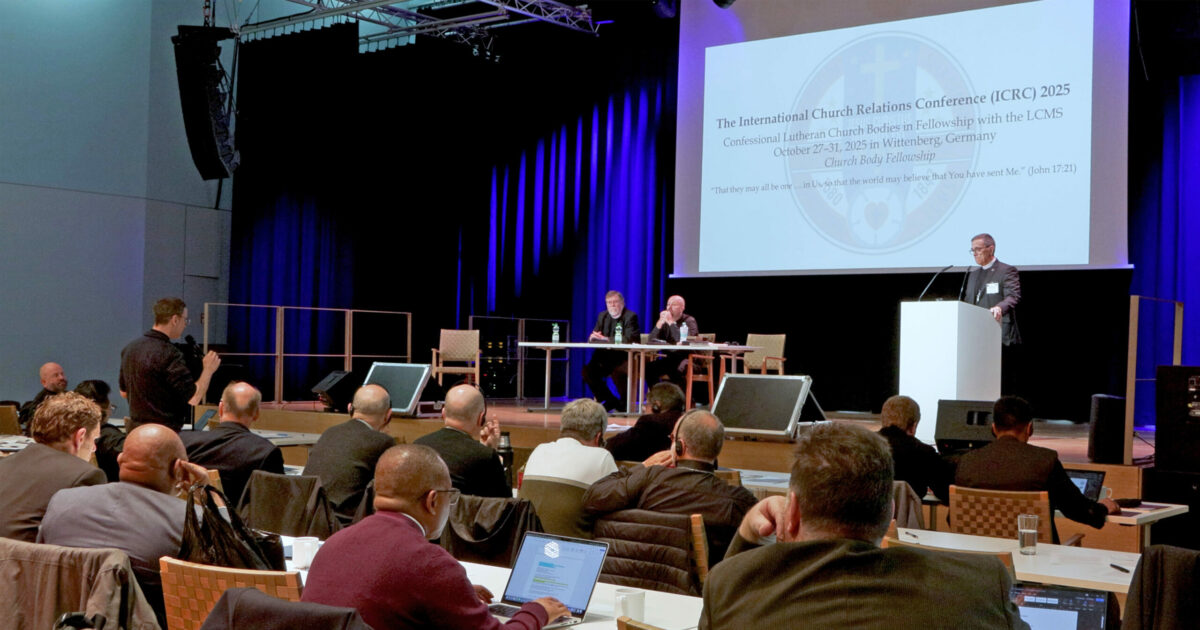
The International Church Relations Conference (ICRC) — an assembly of the confessional Lutheran church bodies in fellowship with The Lutheran Church—Missouri Synod (LCMS) — held its annual meeting Oct. 27–31 in Wittenberg, Germany. Attendees gathered for worship, teaching, dialogue and reflection under the theme of church body fellowship, centered around the verse, “That they may all be one … in Us, so that the world may believe that You have sent Me” (John 17:21).
Ninety bishops, presidents and other church leaders or their representatives from 41 church bodies across 90 countries attended this year’s ICRC. The LCMS currently maintains relations with 104 church bodies, including:
- 44 sister churches in altar and pulpit fellowship;
- 37 associate churches that are working toward altar and pulpit fellowship; and
- 23 other churches that meet with LCMS Church Relations for faithful ecumenicism that clarifies doctrinal agreements and disagreements and makes joint statements that confess biblical truths to a secular world.
The ICRC gathered these churchmen from across the globe for a week of learning and discussion, as well as worship and ample time for fellowship in the form of shared meals and Kaffee und Kuchen — coffee and cake. Topics of discussion at the conference included unity in faith and confession, unity at the altar, and unity in the church working together.
Church leaders and pastors from around the world gave presentations, led reflections and celebrated a variety of worship services. Among them were the Rev. Charles Bameka, bishop of the Lutheran Church of Uganda, who led Vespers on the evening of Oct. 28, and the Rev. Dr. Gleisson R. Schmidt, president of the Evangelical Lutheran Church—Synod of France, who gave the reflection following a presentation by the Rev. Dr. Jonathan E. Shaw, director of LCMS Church Relations. Shaw spoke on “Holding to Christ’s Word Alone: Addressing the Fellowship Fiascos and Failures of Agreements, Associations and Offices.”
“The doctrine of fellowship is really pretty simple: The Word that creates saving faith is the same Word that unites the faithful,” says Shaw, whose essay explored what creates church body fellowship and what destroys it, in order to stir up love for the former and defense against the latter. “Sadly, many erring churches dismiss the authority of God’s inspired, inerrant Word and corrupt the doctrine and practice of church fellowship.
“They do this by adding to or subtracting from the Word of God and requiring other principles for church unity, such as reconciled diversity, doctrinal convergence, episcopal polity, Gospel reductionism, social justice, gender redefinition and diversity-equity-inclusion. That is what the second half of the essay is about. False ecumenism replaces divine doctrine with human principles. Our churches need to be on guard against such satanic deception. We hold to Christ and His Word alone for our salvation and our unity.”
Other representatives from the LCMS included the Rev. Dr. Richard J. Serina Jr., associate executive director of the LCMS Commission on Theology and Church Relations, who presented on triangular fellowship among church bodies, and the Rev. Michael N. Frese, LCMS Church Relations deputy director. In “Confessional Unity as the Basis for Church Body Fellowship,” Frese stressed the importance of viewing church body fellowship as being about more than agreement on a minimum number of doctrines, but rather “agreement in the Gospel in all its articles.”
In an interview, Frese explained, “True unity is not something we negotiate — it is something Christ gives through His Word, and we confess it together.” He added, “The talk helped many leaders by giving a clear, positive rationale for how we seek unity: We gladly partner and pursue fellowship, but only on the foundation Christ gives through His Word and [as] confessed in the Lutheran Confessions. Several presidents and bishops said the presentation provided welcome clarity amid pressures to settle for ‘lowest-common-
denominator’ cooperation.”
The Rev. Dr. Matthew C. Harrison, president of the LCMS, was celebrant and homilist for the Festival of the Reformation Divine Service at the Chapel of the Old Latin School (OLS), a Reformation-era confessional Lutheran school that is now the hub for the LCMS’ confessional Lutheran studies, conferences, retreats and Gospel outreach in Wittenberg. The OLS sits immediately next to St. Mary’s Church, the church in which Martin Luther preached in addition to his duties as a university professor.
Harrison preached that, while the Reformation has been understood in ways valorizing Luther as an individual hero, in nationalistic ways about the formation of Germany as a nation-state, and in cultural-historical ways stressing a turning point against absolute authorities, it is ultimately a moment in church history, a theological event. The Reformation “affected many other things, but it was the event of a troubled conscience coming to realize that his salvation was absolutely outside of himself, caused by God, and a gift; and that soothed his conscience.”
Harrison continued: “Whether a conscience numbed into nihilism or sinning and spinning and agitated confusion, the Word of God stops the death spiral, and it says, ‘Every mouth be stopped.’ It is the end of self-justification, which is the most frequent habit of every single human being. … ‘The righteousness of God through faith in Jesus Christ for all who believe’ [Romans 3:22]. Believe it, and it’s yours. Do you believe in Jesus? Do you believe He has taken upon Himself all of your sins, has forgiven all your sins? He’s yours. Believe it. It’s all yours. There’s no distinction, no difference, no racial preference, no cultural criterion, no class distinction, no geographic difference, no IQ requirement, no human qualification, no human quality, no human quantity — for all have sinned and fallen short of the glory of God. All. And all are justified by His grace as a gift. It’s free. It’s yours. I tell you right now, it’s yours.”
Video recordings of the presentations from the 2025 ICRC will be posted on the LCMS resources website when they are available. To view recordings from last year’s conference, visit thelc.ms/icrc-2024-video-presentations.
Posted Dec. 10, 2025

