
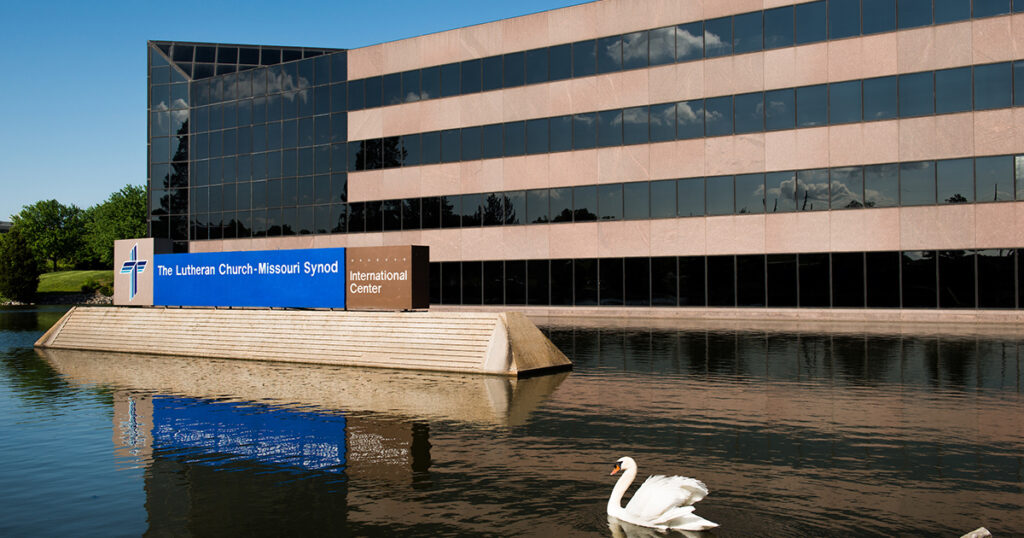
In September, in conjunction with the installation of The Lutheran Church—Missouri Synod (LCMS) president, vice-presidents, officers and board/commission members, the LCMS Board for National Mission (BNM), Board for International Mission (BIM), Board of Directors (BOD) and Council of Presidents (COP) held their first meetings of the 2026–2029 triennium in St. Louis.
BNM
Sept. 17–18
The BNM began its meeting at the LCMS International Center (IC) on Sept. 17 by welcoming newly elected members Rev. Thomas Chryst, David Daniels and Sarah Rausch. (Continuing on the board are the Rev. Peter Bender, the Rev. Timothy Droegemueller, Carol Hack Broome, the Rev. Craig Niemeier, Crysten Sanchez, the Rev. Michael Schuermann, the Rev. Dr. Dien Ashley Taylor and Stephen Weller.) The board then elected a new chairman (Bender), vice-chairman (Schuermann) and secretary (Sanchez).
Following BNM policy presentations from ministry leaders representing various areas of the LCMS Office of National Mission (ONM), Bender thanked the ONM staff: “I think this is the first time in my time on the board that I have seen such a close alignment in the ONM … presentations. … Every one of you touched on ‘fraternal cooperation.’ I appreciate that.”
A Q&A session followed, with board members given the opportunity to ask questions about ONM work. Bender told the ONM staff, “We as a board support the work you’re doing. We as a board pray for the work you’re doing.” He then asked them to talk about the things that impede the work they are trying to accomplish. Answers touched on staffing needs, effectively getting the word out about ONM resources, and the challenges of accomplishing work in a timely manner when there are so many stakeholders and moving parts.
Wrapping up the mutual time of sharing, LCMS Chief Mission Officer (CMO) Rev. Daniel Galchutt, who is also currently serving as interim ONM executive director, said, “One of my goals is to make sure collaboration grows between the board and ONM staff. … I hope this is a good start for the triennium and look for good things to come.”
Later in the day, the BNM was joined by the BIM to hear Galchutt’s CMO report, which included updates on:
- Work underway on the IC’s constituent relationship management (CRM) system and the Synod website;
- Structural changes, adopted at the 2026 convention, creating the position of LCMS chief operating officer (COO) and moving the operational aspects of both Communications and Mission Advancement under the COO (with the CMO retaining responsibility for messaging);
- IC staffing, with the greatest priority currently going to filling the vacant positions of ONM executive director and LCMS School Ministry director; and
- The implications of 2026 Resolution 9-16A, which amended Synod Bylaws to grant more authority to the BNM and BIM, including more oversight of budgeting.
On Sept. 18, meeting at the St. Louis Airport Hilton, the BNM received a draft of a three- to five-year ONM strategic plan, which included an overview of desired outcomes and metrics for measuring progress toward those outcomes, and an update on the ONM Fiscal Year 2027 budget.
BIM
Sept. 17–18
The Rev. Dr. Cory Rajek, executive director of the LCMS Office of International Mission, opened the BIM’s first meeting of the triennium with a meditation on Psalm 130.
“‘Out of the depths I cry to you, O Lord!’ is not exactly the best theme verse to kick off a board meeting,” Rajek said. “But that’s where mission begins. It begins in the depths. It begins with the recognition that we are poor, miserable sinners.”
The church’s calling is simply to be faithful and to share the Gospel that it has been given by God, he continued. Then we trust that the Holy Spirit will create and sustain faith, as we confess in the Third Article of the Apostles’ Creed.
“Psalm 130 gives us three convictions to carry into our work,” he told the board. “First, we are beggars. … Second, the Lord works through His means. We proclaim the Word, preaching Christ crucified and risen for sinners and rightly administering the Sacraments. And then we leave the results to God.”
Following Rajek’s devotion, the board’s first order of business was the election of its officers. The Rev. James Douthwaite was elected chairman by acclamation, with Jim Wolf elected as vice-chairman and Adam Fosse as secretary.
The board then heard two reports from Asia. The Rev. Matthew Wood, interim director for the Synod’s work in Asia, joined via Zoom to talk about strategy in the region. He also discussed the rollout of FOROs, which bring together supporters to collaborate on the planting of churches in a particular area. FOROs have already been held in the Philippines, with new FOROs in the works for Australia and Japan this spring.
Dr. Doug Grove, head of school at Concordia International School Hanoi (CISH), then joined to give an update on the school. CISH opened the school year in mid-August with 556 students representing 27 nationalities — bringing the school close to max capacity.
In addition, the BIM approved a new call for a missionary already serving in Asia, a solemn appointment for an international educator in Asia, and a new call for a U.S. Navy chaplain.
BOD
Sept. 17–18
Immediately upon opening its meeting, the BOD elected Andrew Grams the new chairman and Leo Mackay Jr. the new vice-chairman.
“I am privileged and honored to serve the Board of Directors and humbled to lead this group of faithful servants,” Grams wrote in an email following his election. He sees the work of this new board as bringing to fruition the work of the preceding board.
“Over the next triennium, we hope to build upon the accomplishments of our last term. Continuity is important for this board … and that continuity will enable us to continue to develop, foster and strengthen relationships across Synod; modernize Synod operations through structural and other changes that better equip the Synod to support and serve the work of the church; and ensure long-term stability and growth of the Synod’s financial foundation,” he elaborated.
During the two-day meeting, the BOD began working through the implications and actions required by Resolutions 9-08 and 9-09. Res. 9-08 combined the LCMS chief financial officer and chief administrative officer roles into the new position of COO. Res. 9-09 restructured the work of LCMS, Inc., under the CMO and the new COO role. The board heard plans from Interim COO Blake Warren regarding the initial steps being taken to ensure compliance with the new Bylaws and develop a job description and initial timeline for hiring the new officer.
In his report to the BOD, Harrison said, “We are in a very blessed position in many respects.” Among the positive developments for the LCMS, Harrison reported on the inaugural convention of Lutheran Mission–Australia, which unanimously recognized fellowship with the LCMS during its convention.
“It’s a great joy to be in fellowship with a church in Australia. We’ve not had that in the last 60 years,” Harrison stated.
Warren reported that the financial position of the LCMS remains solid, but some areas warrant ongoing observation. Decreased receipts from LCMS districts and lower-than-projected individual gifts this year are negative bellwethers of a potential uncertainty in funding. Warren noted that, in many cases, decrements in district giving were preceded by significant cuts at the district level, itself also a concern worth noting.
On the positive side, the LCMS received almost record bequest revenue for the fiscal year. These bequests were largely given to restricted funds, which support ministries but not general operating expenses. Investments also performed well this past fiscal year. The combination of revenue from bequests and investments enabled the Synod to have another strong financial year despite some significant, unexpected expenses. Warren noted the inherent uncertainty of relying on income from bequests and interest from investments, cautioning that the Synod’s revenue streams, while strong, require ongoing monitoring to maintain the financial footing established in the last triennium.
In addition to working through the standard reports and restructuring required by the convention, the BOD also heard and approved updates on master plans from Concordia Theological Seminary, Fort Wayne (CTSFW), and Concordia University Chicago (CUC), River Forest, Ill. CTSFW plans to build an improved food and clothing co-op for students, while CUC is expanding its ability to offer locations for training nursing students.
Grams summarized the sense of the meeting among the various board members: “It is truly a great time to serve in Christ’s church.”
COP
Sept. 19–21
Meeting in St. Louis beginning the morning after the installation service, the COP also addressed a number of convention-related issues in addition to its normal business.
The COP reappointed the Rev. Dr. Ely Prieto, Concordia Seminary, St. Louis, associate professor of practical theology, to the Commission on Theology and Church Relations (CTCR) along with two lay members, Bill Frerking and Frederick Guengerich.
In the spirit of Res. 10-04A, which tasked the CTCR to work with the COP to develop a theological and pastoral statement addressing the “God-pleasing Use of Digital Communications,” the council discussed how to respond pastorally to such situations.
“We need to be speaking at conferences about what is appropriate, and what is not, on social media,” said the Rev. Dr. Bill Harmon, president of the LCMS Southeastern District, to the gathered district presidents. He further noted the need of the presidents to “lower the temperature and bring things down a couple of notches” when conflicts break out online.
In regular business, of particular note was a presentation by the Rev. Jonathan Hein, director of the Commission on Congregational Counseling and advisory member of the Synodical Counsel for the Wisconsin Evangelical Lutheran Synod (WELS). Hein offered a short overview of the WELS and then dug deeply into statistical analysis of demographic trends in the synod he represents.
With over a 95% compliance rate in completing requests for congregational statistics and surveys, the WELS has a very robust picture of how its congregations are being affected by demographic, cultural and financial trends. The analysis has enabled the WELS to develop programs to help churches on the edge of closure in unexpected ways.
Finally, the COP also spent time hearing from each district president regarding topics to address in the upcoming triennium. Common topics included a desire for greater clarification on the “ordo” or structure of the Divine Service, as well as related questions of adiaphora, which are rites neither required nor condemned by Scripture and the Lutheran Confessions.
Posted Oct. 14, 2026

