By Cheryl Magness
Even under the best of circumstances, the management and upkeep of a church parsonage is a complex undertaking. A parsonage is owned by the congregation, but it is inhabited by the worker. It is not difficult to imagine how those interests, while they are not opposed, may sometimes intersect in uncomfortable ways.
When the congregation-worker relationship is healthy, and good communication has been established, conversations about the parsonage are easier to have. But when open communication and mutual trust are lacking, those conversations may turn into minefields in which every step has the potential for misunderstanding and hurt.
Why is talking about the church parsonage so difficult? Sometimes good but misplaced intentions get in the way. The church worker doesn’t want to be a burden or knows that the congregation is facing other challenges, so he puts off bringing parsonage issues to their attention.
Other times, even when the worker brings issues to congregational leadership, those issues are not addressed in a timely or adequate way. Conversely, the congregation may be willing to carry out necessary maintenance but encounters resistance from a worker who is reluctant to grant access.
Unfortunately, the result is that, while there are many positive stories of church workers across the Synod who have been blessed to live in comfortable, safe and well-kept parsonages, and of workers and congregations partnering in harmonious ways to care for those homes, there are also stories of neglect of parsonages leading to workers living in unhealthy/unsafe circumstances or to worker-congregation conflict. The Rev. Dr. D. Richard Stuckwisch, president of the LCMS (Lutheran Church—Missouri Synod) Indiana District, says it’s an issue “that needs to be talked about and addressed. I think the problem is probably more rampant than any of us suspects.”
A hidden danger
Jennifer Schmidt agrees. When Schmidt, an LCMS pastor’s wife, began to experience health issues in 2015, she never imagined that the cause was the parsonage in which she, her husband and son were living.
“About every three months, on average, for three whole years, I was diagnosed with a new autoimmune disease,” Schmidt shared. “As soon as we figured out what one collection of symptoms meant … my body would start doing something different.”
In 2018, shortly before Holy Week, Schmidt spent 12 days in the hospital. By that time, she had lost a significant amount of weight, and there were few foods she could tolerate.
“My nutritionist came to see me in the hospital and said, ‘We’ve done all the things that should have improved your symptoms, but you’re getting worse, not better. I think it’s time to test your house for mold.’”
Thus began another odyssey of digging for answers — this one leading to the discovery that the parsonage in which Schmidt and her husband and son lived had high levels of mold. Not everyone is equally vulnerable to mold, but for some, its effects can be devastating. In Schmidt’s case, her health began to improve after her husband took another call and the family moved, but full recovery took years. The emotional strain and financial consequences (losses from mold are not usually covered by insurance) were also severe.
How big a problem?
It is difficult to know exactly how widespread a problem deferred maintenance in parsonages is. There isn’t a central Synod database of which LCMS churches have parsonages or which ones are currently being used as church worker residences (some churches have parsonages that are no longer used).
But what is becoming increasingly clear is that many LCMS parsonages are not maintained as well as they should be. This can be for many reasons — because the worker does not bring issues to the congregation’s attention, because of the cost associated with upkeep, because of lack of clarity about who is responsible for the upkeep, or because of simple ignorance. (How many homeowners can relate to the experience of discovering a problem due to neglected maintenance that they never even knew they should have been doing?)
Nevertheless, even without hard statistics about the extent of the problem, there is enough anecdotal evidence to indicate that deferred maintenance of parsonages is something that needs more discussion. Following her ordeal, Schmidt began looking for ways to bring attention to the issue of dangerous mold and to network with others facing the same issue. She is currently up to 16 families across multiple states, a number that includes not only pastors’ families but other church worker families as well.
Lutheran Church Extension Fund (LCEF) is just one of many voices in the Synod that is deeply concerned about the issue of deferred maintenance of parsonages and trying to help. Vanda Toner, LCEF senior vice-president for district solutions, reports that, in the last 10 years, LCEF has funded at least 50 parsonage-related loans, although that number is probably even higher when taking into account larger projects that may include a parsonage.
Toner said, “LCEF is here to help congregations navigate the challenges of parsonage remediation and remodeling. Our specialized Ministry Improvement Loan offers funding for up to $150,000 with interest-only payments for the first two years, and most unsecured loans receive a quick approval.
“For needs that exceed that amount, we also offer construction loan options. Congregations interested to explore options and ready to begin are encouraged to reach out to their LCEF district vice-president, who will discuss financing options and guide them through the lending process. LCEF stands ready to partner, explore solutions and support the work that strengthens ministry.”
Ongoing need for maintenance
Many congregations find that the best time to carry out major parsonage projects is between pastors, while the parsonage is empty. But it’s important for both congregations and workers to remember that effective parsonage care is an ongoing process.
When their former pastor retired, Christ the King Lutheran Church in Newtown, Conn., took advantage of the opportunity to make improvements to the parsonage. The congregation removed carpet, refinished hardwood floors, stripped wallpaper, repaired and repainted walls, replaced aging fixtures and did general repairs.
But those updates were only the beginning. Christ the King’s pastor, the Rev. Robert Morris, reports that since that time, many additional improvements have been made, including replacing the parsonage’s windows, driveway and septic tank; completely remodeling the kitchen; and building a new back deck. The congregation is blessed with several members skilled in construction, HVAC, electrical and plumbing, so they have been able to do much of the work themselves, saving thousands of dollars.
Gary Gollenberg, a former longtime member of Christ the King (he recently moved) who served in various leadership roles during his time at the church, says that caring for the parsonage is not only smart; it is the right thing to do.
“It protects the congregation’s investment. … But [it also gives] the family a nice place to live, a place they can be happy in and feel proud of. … It also makes it more likely that they will care for the home, since it was in good shape to begin.”
Gollenberg adds that working on the parsonage was an opportunity for the congregation to come together on a shared project. “Some people helped carry stuff to the dumpster, others brought food. … It was a total congregation effort.”
Unexpected blessings
But sometimes, for varied and complex reasons, necessary maintenance is not done, and the parsonage becomes not merely dated or rundown, but unsafe. Yet as difficult as such situations are, for both the worker and the congregation, it is possible to address and even find blessing in them.
Like Jennifer Schmidt, Deaconess Maryann Hayter became ill due to mold that had long gone undetected in the parsonage that she and her husband, the Rev. Mathew Hayter, have lived in for 15 years. Her symptoms came on slowly, but in 2020, when so many people began working from home due to the COVID-19 pandemic, they rapidly got worse.
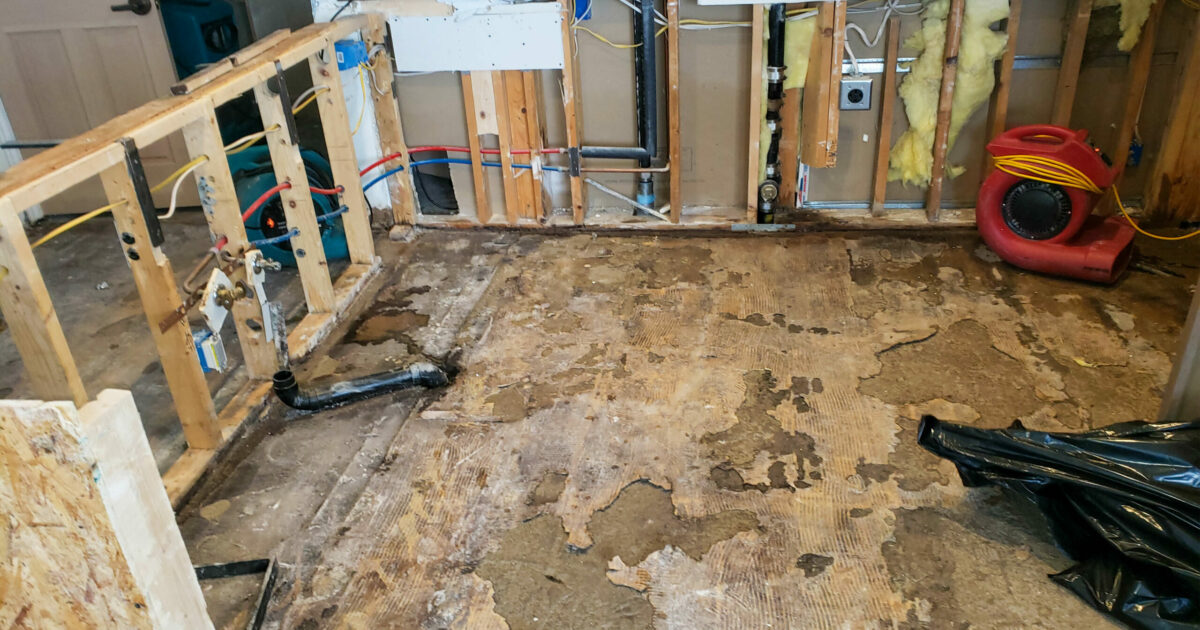
As they searched for answers, the Hayters recalled that Maryann always felt better in the winter. Finally, in March 2025, “something clicked.” As she dreaded the return of warm weather, “I asked Mathew to unscrew the vent cover in the living room.” The visible part of the vent cover looked normal; the back side was covered in mold. So were all the ductwork and the entire HVAC system, which explained why the parsonage — which used boiler (radiant) heat in the winter and forced air in the summer — led to a worsening of Hayter’s symptoms in warm weather. Mold was also discovered in the finished basement, the result of hidden water damage from multiple cracks in the foundation.
Once they realized the extent of the mold, the Hayters moved out. For the next six months, they lived in temporary housing, during which time Hayter’s health rebounded. Also during that time, the congregation set about not only remediating the mold, refinishing the basement and replacing the HVAC system and ductwork, but also remodeling the kitchen and bathrooms in the 70-year-old parsonage.
Hayter recommends other churches do what the Hayters’ congregation did, which was to create a parsonage committee to deal with the renovation. While the committee was formed to address the mold issue, the Hayters hope they will make it permanent. The benefit of such a committee, says Hayter, is that it can serve as a kind of “middleman” to deal with parsonage issues — a “safe place” to bring parsonage concerns, which are then communicated by the committee to the congregation on the worker’s behalf. The parsonage committee at Hayter’s church consists of the Hayters, three laypeople recommended by them and approved by the church council, and one church trustee.
Looking back on her ordeal, Hayter sees many unexpected blessings, including deepening relationships with people in the congregation, particularly the “army of widows … [who] have brought me so much joy and so much care and help”; learning that it’s OK, as a church worker, to ask for help; and simply seeing the church come together to care for the worker. The congregation did not get a loan for the parsonage project but was able to pay for it all in cash. Still, Hayter notes, it was an enormous amount of money that required the congregation to step out in faith. After they did so, a significant gift came in that made it much more feasible.
“Sometimes we have such narrow thinking that we think that God must provide in one particular way,” Hayter said. “We can be too much like Sarah, who thought she needed to help God carry out his plan [Gen. 16]. But as my husband has repeatedly told me throughout this process, the Lord provides.”
No easy answers
If you are a church worker who is worried that your home is in any way unsafe, unhealthy or not serving your or your family’s needs — whether due to mold, another environmental issue, or something such as lack of necessary maintenance or accessibility — the first step is to bring your concerns to your congregation. Many workers don’t do this because they don’t want to cause “trouble.” They may simply ignore the problem or try to fix it on their own.
But, as Indiana District President Stuckwisch observes, the key to working through these situations is communication. “Church workers should not hesitate to bring concerns to the appropriate congregational leadership,” Stuckwisch says, “and if necessary, to the circuit visitor, who can evaluate whether the issue needs to be brought to the district president.” None of this is easy, but it is necessary. Stuckwisch also encourages workers considering calls to ask questions about the parsonage and its condition, and even to request safety inspections similar to those the typical homebuyer does before purchasing a home.
Deaconess Dr. Tiffany Manor, managing director of the LCMS Office of National Mission, encourages the church to see the parsonage and its proper maintenance as an important aspect of church worker wellness:
“Like all people, church workers need living conditions that keep them safe and healthy. God’s people are called to care for one another as the Body of Christ. If one member is unwell, it will impact the entire body. When church workers are unwell, they are less able to serve with the energy and vitality needed in their vocations, and that can begin to affect the entire congregation.
“When we install church workers into our congregations, schools and Recognized Service Organizations, we make promises to our Lord, to the workers and to each other that we will support them. This is manifested in many ways — by praying for them, paying them salaries, providing health plan coverage and making sure they have safe and healthy lodging. We make personal sacrifices to give and provide for them, which is fitting since our workers sacrifice a great deal to serve us and our Lord.
“As the Body of Christ, we are strengthened to serve one another in love by Him who paid the ultimate sacrifice for us.”
For more information, visit lcms.org/wellness and lcef.org/districts.
Posted Jan. 2, 2026

