
By Mary Henrichs
“The study of theology is not pursued as a means to ascend the … intellectual ladder to heaven, but as a response to the rich and immeasurable love that we perceive through the precious blood of Jesus,” said the Rev. Dr. Kendall Davis, assistant professor of New Testament Studies at Concordia University, St. Paul (CSP), preaching in Graebner Memorial Chapel for Matins during the 2026 Theology Professors Conference.
Although the 75 theology professors in attendance from the Concordia universities and seminaries across the U.S. and Canada teach a wide variety of students in a wide variety of contexts — from those just fulfilling a theology requirement to those pursuing church work or preparing to enter the Holy Ministry — they are united, Davis said, in the “proper motivation and goal” of their teaching: “the love of God the Father.”
In today’s culture, Davis said, it can be tempting for students to “see the study of theology only in terms of what their career will require,” and to consider that the value of theological education lies only in “what we have immediate use for.”
But “love motivates people to do all kinds of crazy things. The love of God may be just enough to motivate our students to learn their languages, to crack open the Book of Concord, maybe even to actually go to the library and do that research.”
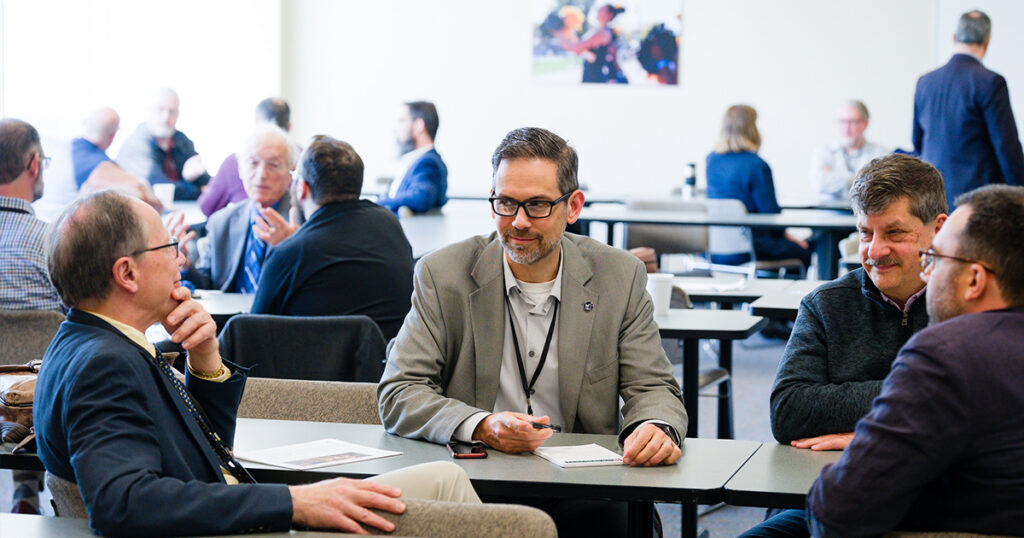
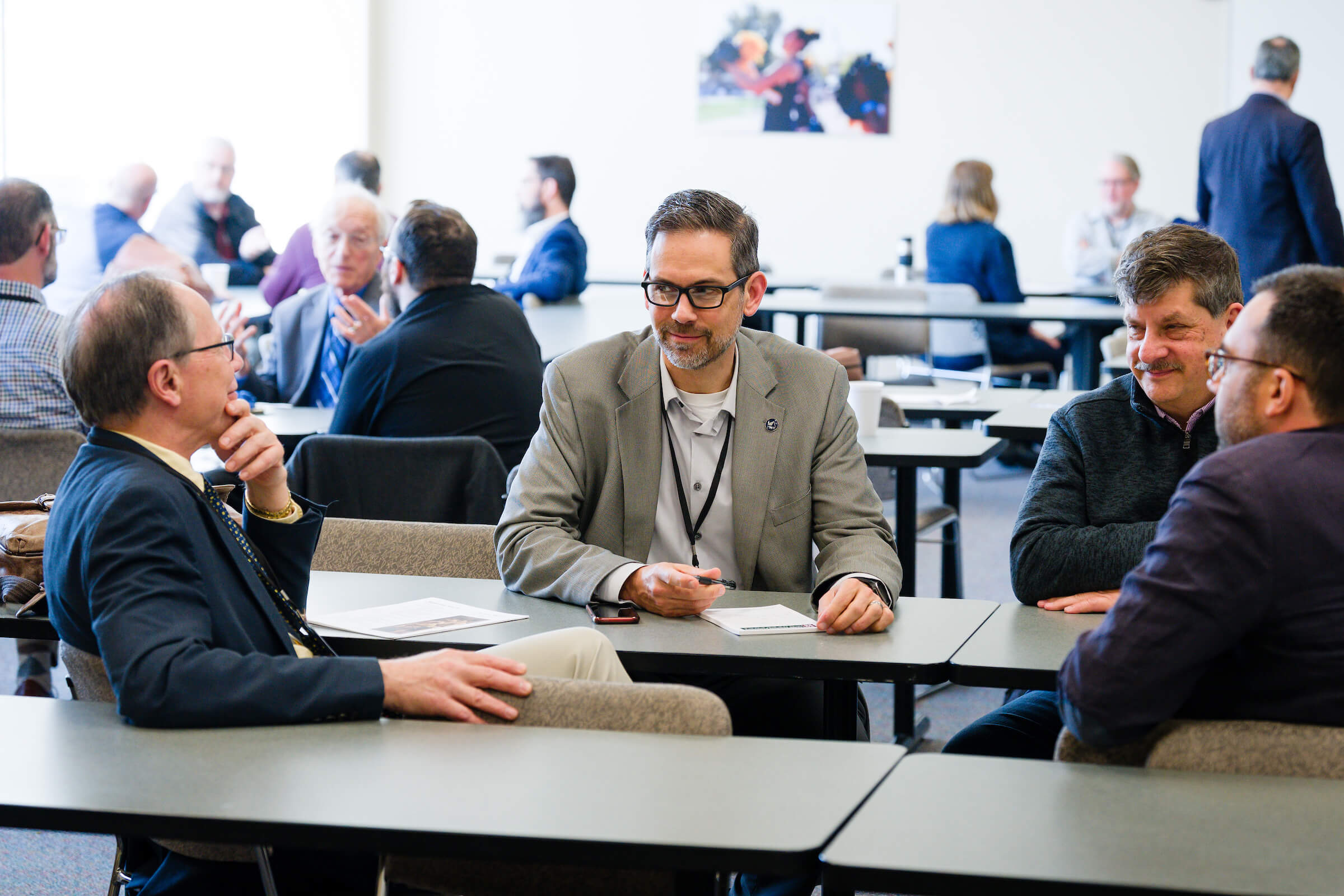
In the case of these professors, love — of God, of their students and of one another — motivated them to begin their summer break from regular classroom instruction with a return to the classroom: For three days, May 18–20, they delved deeply into the study of Scripture and the Lutheran Confessions, receiving refreshment, encouragement and the opportunity to collaborate with and learn from each other.
‘The integrating reality’
Professors became students again in the classrooms of CSP, hearing research from their colleagues at a variety of plenary sessions and sectionals. “To be a good teacher, you have to be a good learner,” said the Rev. Dr. Stephen Pietsch, first-time conference attendee and professor at Concordia Seminary, St. Louis. He emphasized the need for teachers of theology “to keep receiving and learning and growing … so that [they] can go on helping others learn.”
The research presented didn’t shy away from complex and sometimes fraught theological topics, including Christian citizenship, ecclesiastical order and divorce.
In his plenary session, the Rev. Dr. Jacob Corzine, vice-president of publishing at Concordia Publishing House, examined the correspondence between Luther and Melanchthon during the development of the Fifteenth Article of the Augsburg Confession, which deals with church ceremonies. “Conscience requires certainty and clarity about what is commanded by God,” said Corzine, describing the driving force behind the drafting of the article, which begins: “Our churches teach that ceremonies ought to be observed that may be observed without sin” (AC XV I).
Pietsch called Corzine’s in-depth investigation of these source documents “the kind of theology that theologians need to be doing,” as its rich examination of church history holds major implications for today’s ministry. The Rev. Dr. Cameron MacKenzie, professor at Concordia Theological Seminary, Fort Wayne (CTSFW), said that Corzine’s research alone made the entire conference worthwhile.
MacKenzie, in his 43rd year as a professor, led a sectional detailing Luther’s influence on the Tyndale Bible — the first English Bible to be translated from the original Greek and Hebrew — which in turn influenced later English versions, including the King James Version and the English Standard Version so widely used today.
“Christ in the Curriculum: Five Lenses,” a sectional presented by the Rev. Dr. David Loy, dean of Christ College at Concordia University Irvine (CUI), Irvine, Calif., engaged the idea that theology is not limited to theology courses alone, but that every course of study can (and should) be approached with a theological lens. Loy encouraged the professors to think through questions such as, “Who is my neighbor if I’m an English major? A mathematics major?” and “What does it mean to follow Jesus in [a given] discipline?”
During the discussion of the five theological lenses, professors reflected on what Christian success looks like in different disciplines, how the way in which a university conducts business witnesses to its values, and how to build and strengthen connections with faculty members in other disciplines. Said the Rev. Dr. Charles Gieschen, provost at CTSFW, over the course of the small-group conversations, “Theology is the integrating reality at our universities.”
‘That they may all be one’
One often-heard topic of conversation — cropping up around coffee urns, in winding corridors and over lunch — was how best to reach and teach the next generation of students. Professors eagerly shared that church work, pre-seminary and seminary enrollment numbers are up across their institutions, while noting that students often arrive already formed by the culture in which they live. The Rev. Dr. Todd Peperkorn, director of Vicarage and Internship at CTSFW, observed that “‘social’ media — which is supposed to connect people — actually serves to create barriers, so that many young people today are more anxious and … distrusting of strangers than ever before.”
Peperkorn said that since students today indicate that they learn best from someone they trust, with whom they have a relationship, a “brain-to-brain” or “data dump” model of teaching can never be sufficient. This is where the Holy Spirit’s work of hospitality steps in — the theme of his plenary session.
“Hospitality and learning are intimately interconnected,” said Peperkorn, adding that a pastor’s most vivid memory from seminary will often be having dinner at a professor’s home. “When you open your home to a person, you are saying, ‘This is the real me. This isn’t a show; this is who I am.’ … On that basis I can have a conversation and share Jesus. It takes time, it requires vulnerability and effort. It means you’re not just thinking big thoughts but you’re actually cooking for somebody else.”
Throughout the conference, professors from different institutions repeatedly savored meals together, eating, talking and laughing in table fellowship. On the conference’s final afternoon, the professors joined together in the table fellowship of the blessed Sacrament in the Divine Service: “There is no greater expression of the unity that we have than at that communion rail,” said the Rev. Robert Roethemeyer, director of Library and Information Services at CTSFW.
Preaching on Jesus’ High Priestly Prayer in John 17 “that they may all be one,” Davis concluded his sermon earlier in the day: “As teachers of theology, we … should pause before we take up our task and pray for ourselves and our students to receive the gifts that the Father … give[s] us through Jesus. And as we do this, we remember that Jesus Himself has never stopped praying for us. … We still have a great High Priest who prays for us, who sends His Holy Spirit to fill our hearts with the Father’s love, the love that was His from before the world began, the love that is ours now and will be ours forever.”
Posted June 19, 2026

