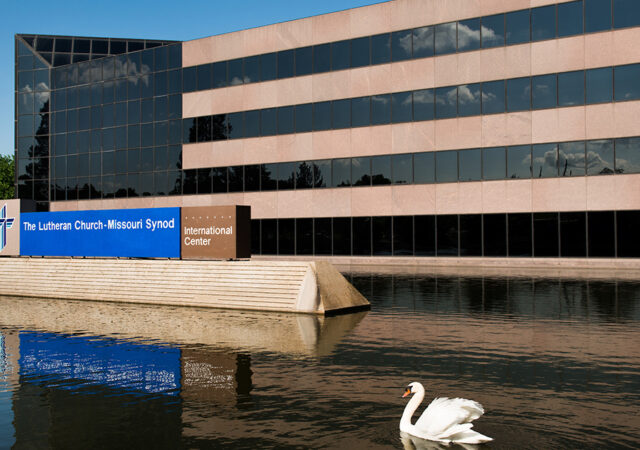
The Lutheran Church—Missouri Synod (LCMS) Board of Directors (BOD), Council of Presidents (COP) and Boards for International Mission (BIM) and National Mission (BNM) met in St. Louis in August and September.
BOD (Aug. 29–30)
The BOD confirmed the appointment by LCMS President Rev. Dr. Matthew C. Harrison of the Rev. Daniel Galchutt as interim LCMS chief mission officer (CMO) and offered a statement of thanks to the Rev. Kevin Robson for his service to the LCMS in the same role. Then Galchutt reported to the BOD on the major priorities at the LCMS International Center (IC) over the coming months, including a thoroughgoing review of the digital platform project, strategic planning with the BNM and BIM, and activity related to the selection and implementation of a new constituent relationship management (CRM) system at the IC.
LCMS Chief Financial Officer Nathan Haak reported on the financial situation and giving trends of the LCMS, noting a preliminarily strong financial close, with significant increases expected in both restricted and unrestricted net assets over the last year, totaling approximately $20 million. While there was an increase in total gifts over the prior year — up $10 million — that’s also offsetting a particularly low year for bequests. The increase in total gifts is largely concentrated in large grants, disaster, and endowment giving, masking an overall decrease in core underlying gifts of over $1 million compared with Fiscal Year 24, a trend that Haak and the BOD are watching closely.
While Haak reported that the overall financial situation of the LCMS is solid, he said he is also keeping a close watch on hiring, in particular. Despite current underspending on the budget, the effects of broad inflation on staff salaries and benefits are significant, and an approach to full staffing is reducing the likelihood of future underspending.
Among other items, the BOD also heard master campus plan updates from Concordia Theological Seminary, Fort Wayne (CTSFW); Concordia Seminary, St. Louis (CSL); and Concordia University Wisconsin and Ann Arbor; as well as a Concordia Plan Services proposal to create a captive insurance company to provide a more stable and sustainable property and liability insurance program for LCMS organizations.
The BOD also approved:
- The 2026 convention budget;
- The commencement of the CRM implementation project;
- The purchase of a building in Wittenberg, Germany, to become a hub for mission, outreach and theological education across the Eurasia region and to support the work of the Synod and its global partner churches;
- The allocation of scholarship funds from the sale of Concordia College New York, Bronxville, N.Y.; and
- Miscellaneous edits to the BOD manual.
COP (Sept. 6–9)
Following each district convention season, the COP elects a new program committee that coordinates the council’s business. Due to health reasons, LCMS Missouri District President Rev. Dr. R. Lee Hagan was unable to stand for re-election (he is making good progress in his recovery), and a new chairman, the Rev. Brady Finnern, president of the LCMS Minnesota North District, was elected. Others elected were:
- Vice-chairman: Rev. Dr. Allan Buss (LCMS Northern Illinois District)
- Secretary: Rev. Justin Panzer (LCMS Kansas District)
- At-large: Rev. John Hill (LCMS Wyoming District)
- At-large: Rev. Dr. Mike Gibson (LCMS Pacific Southwest District)
During his report to the council, President Harrison shared encouraging news on the convention season: “I really came out of those 25 conventions [that I was able to attend] very thankful and energized and hopeful.” He shared that he had received “word from across the Synod that many young men and young families are coming to church looking for authentic and biblical worship and teaching.”
Harrison invited Deaconess Dorothy Krans, director of Recognized Service Organizations (RSO), to update the COP on the state of RSO ministry. The LCMS has 326 RSOs in numerous areas of service, including schools, mercy work and camps. Krans explained the process of evaluating RSOs; as a result of this process, the RSO status of 77 organizations was terminated, denied or withdrawn, or the RSO was dissolved, over the last five years. The COP thanked Krans for her transparency and worked with her on ways to increase collaboration to maintain proper oversight of RSOs operating within the LCMS.
For the rest of his report, Harrison provided updates on work at the IC and by the BOD.
The Rev. Dr. Thomas Egger, CSL president, and the Rev. Dr. Jon Bruss, CTSFW president, together presented on non-residential routes to ordination, the costs associated with these programs, and how they relate to residential programs. Bruss suggested that when SMP (Specific Ministry Pastor) students visit the CTSFW campus, they often recognize the value of residential seminary education, and he encouraged the COP to send prospective SMP students to visit the seminary campuses so that they can fully understand the difference between the two programs before making a decision.
Looking toward the 2026 LCMS convention, the COP heard reports from the Rev. Peter Lange, LCMS first vice-president, and the Rev. Dr. John Sias, LCMS secretary. They touched on preparation of electoral circuits, nominations, submission of overtures, and more. The council also reviewed the status of resolutions assigned to the COP at the last convention and what resolutions require additional work prior to convention.
The COP also heard from:
- The Rev. Dr. James Baneck, executive director of the LCMS Office of Pastoral Education, who outlined the expansion of Set Apart to Serve across the districts;
- The Rev. Dr. Rich Rudowske, executive director and CEO of the RSO Lutheran Bible Translators, who told the COP that by 2033, every language in the world will have some access to the Bible, with 99.96% of languages having the full New Testament and 95% having the entire Bible;
- The Rev. Dr. Gregory S. Walton, who presented on ministry sabbaticals for Grace Place Wellness; and
- The Offices of International Mission (OIM) and National Mission (ONM), each of which reported on matters relevant to work going on in the districts.
Finnern reflected on the meeting as new COP chairman: “I am humbled to serve as COP chair. The COP is called to serve the church for the sake of the Gospel and the care of souls. United in doctrine and practice, we are blessed at our meetings to see the Lord bearing fruit and to address current challenges to support local congregations. Please pray for us as we fight the good fight in Christ’s name.”
BIM (Sept. 4–5)
During its meeting, the BIM approved calls or solemn appointments for five missionary candidates — three for Africa and two for Latin America and the Caribbean — as well as one military chaplain. They also approved a slate of missionaries and chaplains to serve as advisory delegates for the next LCMS convention, set for July 18–23, 2026, in Phoenix.
On Sept. 4, the board heard from leaders at two of the Synod’s international schools, who joined via Zoom.
Dr. Eric Semler, head of school at Concordia International School Shanghai (CISS), reported that CISS has an enrollment of 1,110 students this year. The school is in a good financial position and has embarked on a two-year project to build a new fine arts and aquatics center.
From Vietnam, Dr. Doug Grove, head of school at Concordia International School Hanoi (CISH), reported that CISH has a current enrollment of 557 students. This year, he is focused on making progress in several key areas: assessment alignment, service opportunities and after-school programming.
Both heads of school noted the ongoing need for Lutheran teachers. Grove said CISH has a program for student teachers, while Semler mentioned a two-year program at CISS for recent graduates of schools in the Concordia University System.
During the meeting, the BIM also discussed ongoing work on several resolutions passed at the 2023 convention. LCMS OIM Executive Director Rev. Dr. Cory Rajek noted that an FAQ resource is currently in development in response to Res. 2-05, “To Provide Resources for Discerning Validity of Requests to Support International Mission Work.” This document will provide a list of theological, ecclesiastical, legal and logistical questions for congregations to consider when asked to support international projects with which they may not be familiar.
In addition, LCMS Chief Financial Officer Nathan Haak gave a report on the Synod’s current financial situation (see BOD report), paying particular attention to how the OIM fits within that broader context. He gave a similar report, geared toward the ONM budget, at the BNM meeting (see below).
BNM (Sept. 11–12)
The meeting was chaired by the Rev. Dr. Dien Ashley Taylor, president of the LCMS Atlantic District, who also serves as BNM vice-chairman. After Taylor called the meeting to order, the Rev. Craig Niemeier, BNM member and pastor of Zion Lutheran Church, St. Libory, Neb., offered a devotion on John 19:16–37, the crucifixion and death of Jesus. Niemeier emphasized that Jesus takes the sinner’s “prodigal-ness” and “the weight of the world” with Him to the cross. In doing so, He “makes us able to pray ‘Our Father’” with Him.
The Rev. Daniel Galchutt, LCMS interim CMO, gave the CMO report. He reviewed demographic data reflecting challenges faced not only by the LCMS but by the wider Christian church, emphasizing nonetheless all there is to be thankful for: “We have the pure Gospel of Jesus Christ, which trumps everything else.”
Galchutt, who also serves as ONM executive director, provided updates on:
- The ONM budget;
- Personnel and administrative changes geared toward a more streamlined and blended unit;
- Efforts to report more effectively to stakeholders through the use of online ministry “dashboards”;
- Increased collaboration with the Synod’s seminaries; and
- Growing partnerships with other Synod entities.
Deaconess Dr. Tiffany Manor and the Rev. Michael Meyer, both of whom serve as ONM managing directors, presented the ONM strategic plan. They highlighted the ONM’s efforts, along with the rest of the national Synod offices, to move toward a three-year budget cycle as assigned by the BOD and to work toward greater conversation and collaboration among the widely varied ministries that come under the ONM umbrella. In addition, they highlighted work ongoing in:
- LCMS School Ministry, which is nearing completion of the Lutheran Education Curriculum Standards called for by the 2023 convention;
- Youth Ministry, which has already started planning for the 2028 Youth Gathering;
- LCMS Worker Wellness, which is working to increase the involvement and participation of congregational lay leaders in wellness initiatives and to build on collaboration with Concordia Plan Services which, in Manor’s words, “is going very well”; and
- LCMS Disaster Response, which, according to Meyer, continues to experience rising volunteer engagement. “People are doing a fantastic, wonderful job,” Meyer said.
The Rev. James Douthwaite, a BIM member who is chairing the BIM’s and BNM’s Joint Mission Assessment Committee (JMAC), gave an update on the JMAC’s work. That work, called for by the 2023 convention, will culminate in a report to the 2026 convention. Discussion centered on the process for choosing the Synod’s Mission and Ministry Emphasis (MME) as well as consideration of potential MMEs for the next triennium.
The board welcomed the Rev. Dr. Richard Serina Jr., associate executive director of the Commission on Theology and Church Relations, who reported on the work of the Created Male and Female task force. The task force, which comprises a wide range of individuals —including seminary professors, parish pastors and staff from the IC and other Synod agencies — was created following the 2019 LCMS convention. Its work was extended by the 2023 convention. Serina said the task force currently has two primary focuses: 1) assessing material for its possible usefulness in the LCMS, and 2) conducting field research.
The task force’s draft report will be finalized this fall and presented to the 2026 convention.
Finally, the Rev. Dr. Quintin Cundiff, who was installed as director of LCMS Church Planting in August, spoke to the board about the theology of church planting, grounding his presentation in extensive discussion of Scripture. Cundiff reflected on a common point of discussion among Christians: For whom does the church exist? Does it exist for itself, i.e., the body of believers, or does it exist for those who are outside the church, that they might come to believe? The question, he said, is a false choice because “the church is for Christ.” It is the place from which Christ now carries out His work, through His people, until the day He returns to take them to Himself.
Posted Nov. 18, 2025