By Jeffrey Hemmer
Imagine a monastery composed of 30 mostly new converts to Christianity where police wait to arrest one of the novice monks as soon as he steps outside.
Such is the fear that now grips the Persian Christian community in Germany after the arrest of a man living in the fellowship hall of Trinity Lutheran Church, a congregation of the Independent Evangelical Lutheran Church (SELK) in the Steglitz district of the capital city of Berlin. On Monday, July 28, plain-clothed police officers — who had been staking out the church — arrested him as soon as he stepped outside and off church grounds, just days shy of completing the six months of church asylum required for him to have been granted political asylum.
Following his arrest, the man will likely be deported to Sweden, where he previously lived for 10 years before coming to Germany, and where he converted to Christianity. Once in Sweden, he will likely spend time in a camp before being sent back to his home country of Afghanistan, where he will face possible execution for converting. (His family will probably be allowed to remain in Sweden.)
Exiled, but not from Christ
In the 1960s, when the economy of West Germany was growing faster than the population, the country began receiving immigrants — particularly from Turkey and southern Europe — to fill out the labor force. According to the Rev. Dr. Christian Tiews, LCMS missionary to the Eurasia region, 8–9% of Germany’s population were, by the 1980s, from a “migration background,” meaning they were first-generation immigrants or children of immigrant parents.
Immigration to Germany boomed again in the mid-2010s due to civil war in Syria and the flight of many other refugees, a significant number of whom were Muslim, who came to Germany for its generous welfare system and lax immigration laws. When Russia attacked Ukraine in 2022, another wave of refugees flowed into Germany. Today, nearly 30% of the German population has a “migration background.”
“German citizens initially welcomed the newcomers with flowers and stuffed animals, and refugee camps and shelters started popping up all over the country,” said Tiews, until the influx of foreigners caused cracks in the efficiency of German social services.
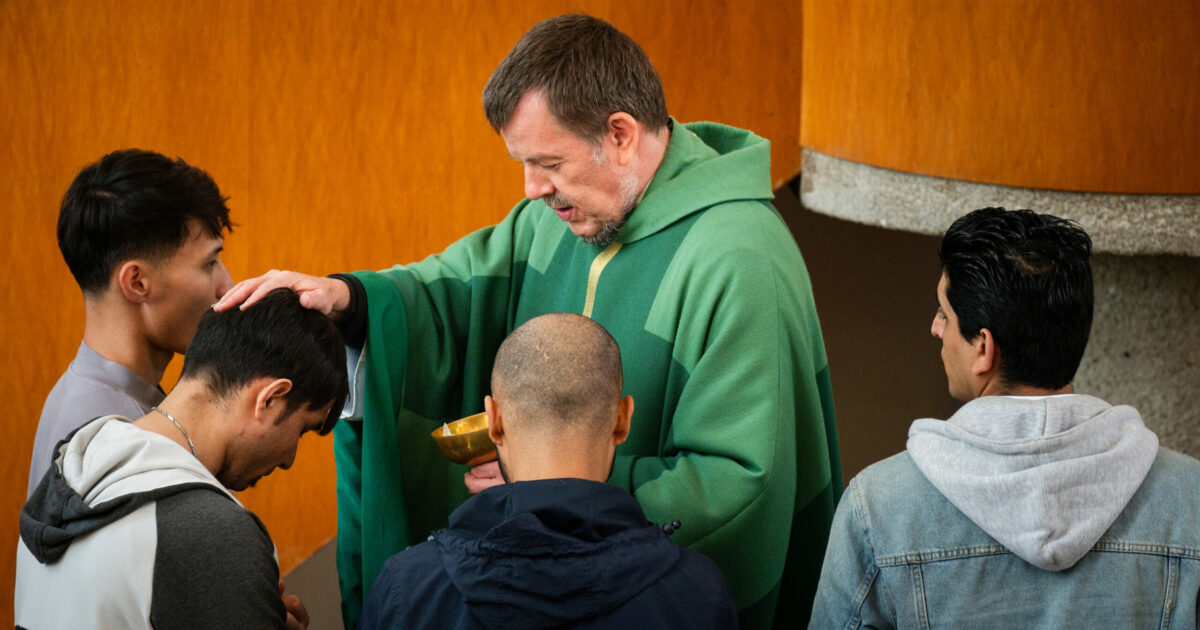
Persian immigrants have been particularly receptive — more so than other Muslims — to the Gospel, said the Rev. Dr. Gottfried Martens, pastor of Trinity, Berlin-Steglitz. Martens’ congregation currently comprises 1400 Persian converts to Christianity and about 300 native Germans.
“When Persians and Afghans become Christian, they don’t want to have a ‘lite’ version of Islam; they want to have the total opposite,” said Martens. “The total opposite of Islam … is Lutheran theology. Islam is always thinking about the god who is far away and … very big. And now they experience, especially in Lutheran theology, that God is making Himself small, so that you can even touch Him with your lips in the Sacrament.”
“In Islam,” Martens, continued, “they [don’t have] the certainty of salvation. From childhood on, they were told ‘You will go to hell.’ … And now they hear that there is a place where it is said to you, ‘Your sins are forgiven.’ And that is so great to them. … They love the personal absolution.”
While there are certainly some Muslim immigrants who use Kirchenasyl — church asylum — as a disingenuous shortcut to political asylum, that is not easy to do at Trinity or the other SELK churches with large Persian populations. Refugees seeking asylum in these Lutheran congregations go through 30 days of intense catechesis and must pass an exam before they receive the Sacrament of Baptism.
And while Western Christians are familiar with renouncing “the devil and all his works and all his ways” in the baptismal rite, these former Muslims have insisted on adding a renunciation of Mohammed and Ali as well. “In so doing,” said Tiews, “they are writing off their families and their culture. They are making themselves exiles by coming to Christ.”
Once the six-month period of church asylum is over, refugees are not required to stay in the church anymore, but Martens reports they keep coming to Trinity. “After the church asylum, they do not want to go to any other church, where they do not receive Christ’s true body and blood and [where they] cannot receive personal absolution. Iranian and Afghan Christians go long ways to our church, driving up to 7 or 8 hours each weekend — one way. They come not only for the worship services, but also the Bible studies, baptismal classes and counseling in Farsi.” (Martens is fluent in Farsi.)
Different cultures, same Lord
But the political climate in Germany is changing. Tiews explained, “The new anti-immigration sentiment of many ethnic Germans was reflected in the election of a more conservative government in Berlin earlier this year, which is tougher on immigration than the previous administration. The authorities are also stepping up the deportation of illegals and immigrants who have committed serious crimes in Germany.”
As the popular and political climate in Germany has turned against immigration and asylum, church asylum has come under the spotlight. On July 15, the mayor of Hamburg, Peter Tschentscher, published a strongly worded letter, accusing Berlin mayor Kai Wegner and the Berlin city government of abusing the process of church asylum and seeking the arrest of four Afghanis.
The beauty and comfort of the Gospel is nearly impossible for these former Muslims to resist. “We don’t have any outreach strategy,” said Martens. “We don’t have any method. Our method is just Word and Sacrament and nothing else. But when these people hear the Gospel, they can’t be silent; they invite their friends. That’s how people come to our congregation. Not because of any big things we perform here, but [because] we simply do our normal worship services; we do our baptismal classes; and people are so moved by [the Gospel] they bring their friends. I am not the missionary here; the missionaries are the members of our church.”
But with the recent arrest and the intense scrutiny of Trinity in the media, the Afghan Christians are scared. “The other Afghan Christians in our church asylum are totally shocked and full of fear now,” said Martens. “I try to comfort them. But there is something even worse than this single arrest: Since the beginning of the new government, Afghan Christians get deportation letters full of hateful rhetoric and anti-Christian sentiment, and Germany bends to the will of the Taliban at the price of sending back Afghans to them.”
The ordeal is also taking its toll on those trying to help. Tiews reported that Martens is regularly approached by the media for interviews (and gives many) and that he is “heartbroken” by what has happened.
The Rev. Dr. David Preus, director of the LCMS Eurasia region, highlighted the politicization of the topics of migration and immigration, which “clouds what’s really going on. That’s not the reality. The reality is that the Gospel of Jesus for the forgiveness of sins is being preached to people. They’re hearing it … believing it … confessing it. They’re going to the Lord’s Supper and receiving forgiveness. They’re receiving absolution.”
Preus added that, while those in the LCMS who are Americans “might not have much in common with these people from a cultural [and] language perspective, [they] have more in common with … these Iranians, with these Afghans, than with many [in their] hometown because [they] confess the same Christ.”
Given the political climate, it is likely that arrests and deportations — and executions — will increase. But these new Christians are still coming to Martens for Baptism, catechesis, absolution and the Lord’s Supper.
They need their fellow Christians’ prayers and support. And we need the example of their courageous confession of Christ at the risk of personal comfort, safety and even earthly life.
Read more about Trinity-Steglitz.
Find Lutheran Witness podcasts about mission work in Germany.
The Rev. Jeffrey Hemmer is pastor of Bethany Lutheran Church in Fairview Heights, Ill.
Posted Aug. 6, 2025/Updated Aug. 6, 2025

