By Mary Henrichs
Editor’s note: This story has been updated to note that the tax credit begins with the 2027 (not the 2026) tax year. In addition, readers are encouraged to watch for a list of approved/known Lutheran scholarship granting entities to be released by the Synod/LCMS School Ministry once the U.S. Treasury Department has released its final guidelines on the tax credit. In the meantime, be alert to phishing attempts or false information from unreliable sources.
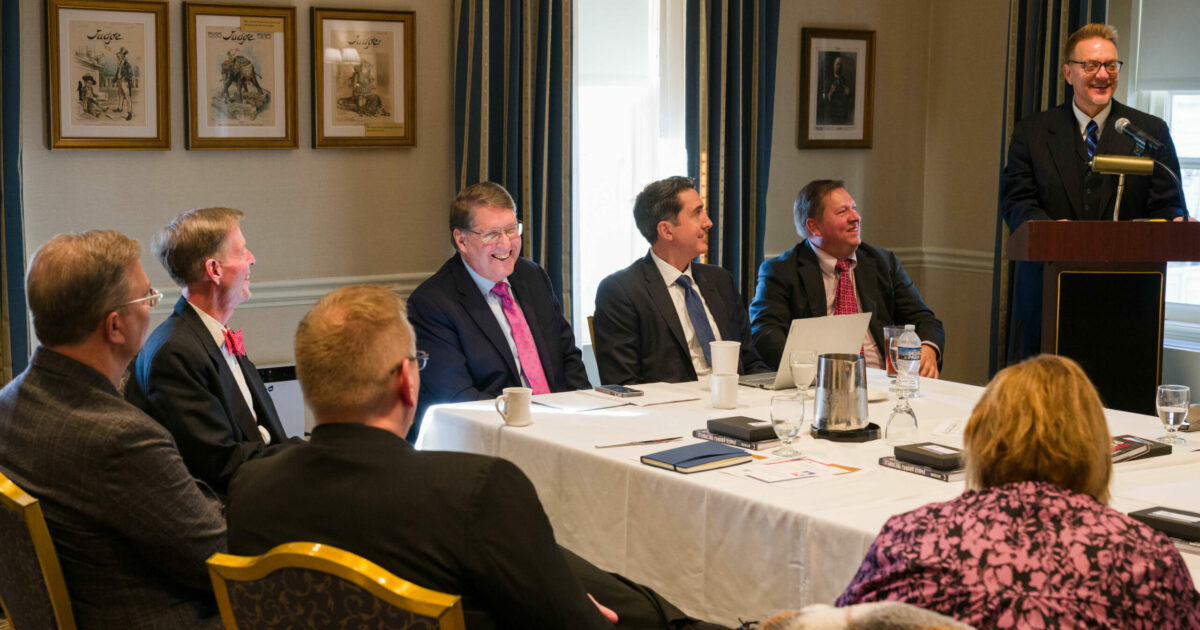
On Nov. 17, LCMS (Lutheran Church—Missouri Synod) church and school leaders from around the nation took part in a roundtable hosted by the Synod’s Lutheran Center for Religious Liberty (LCRL) in Washington, D.C., funded in part by a grant from the Lutheran Women’s Missionary League. The goal of the meeting was to promote an understanding of forthcoming major changes to funding for Lutheran schools created by the One Big Beautiful Bill Act (OBBBA), which became law in July 2025.
The OBBBA offers a federal tax credit of up to $1,700 for individuals who contribute to Scholarship Granting Organizations (SGOs). Ashling Preston, associate director of Government Relations for the United States Conference of Catholic Bishops, explained it this way: “You can literally give for free. If you have more than $1,700 dollars of [federal tax] liability, which we estimate that if you make more than $50,000 a year, you probably have … you can give for free. It does not cost you anything to give.”
Preston noted that donors with $1,700 in federal tax liability (beginning with the 2027 tax year) will turn over this money anyway, but now they will have a choice where it goes: “I get to decide if my money goes to Washington or to fund a child’s education.”
Although a $1,700 contribution may seem small compared to the full price of private school tuition, the funding generated by this tax credit has enormous potential. The $1,700 cap is on donations, not on the amount students may receive. Preston said that fiscal models suggest $30 billion could be raised in the next 10 years.
The OBBBA is the first federal program of its kind, and it makes these scholarships available to a wide population of children: Any child who is eligible to enroll in public elementary or secondary school and whose household income is below 300% of the area medium gross income is eligible to receive this funding through an SGO. The types of educational expenses that can be covered by the funding are expansive too. SGOs can offer scholarships not only for tuition, but also for curricular materials, books, tutoring, advanced placement tests, educational therapies for students with disabilities, and more.
The Treasury Department is currently working out the exact implementation of the law, meaning that certain questions are yet to be resolved, such as whether the $1,700 contribution will be per household or per person. If the contribution cap is per person, married couples could contribute $3,400 and receive the dollar-for-dollar tax credit. Other questions include the potential for SGOs to grant scholarships toward homeschooling students or students attending microschools, and how exactly states will complete the opt-in process.
States are required to opt in to the program each year in order to accept the funding generated by this tax credit, and some governors, such as those of Wisconsin and Oregon, have already declared their intent to opt out. However, even if a state opts out of receiving funding, the citizens of that state are still able to contribute to the SGOs of other states and receive the federal tax credit.
Meeting attendees expressed excitement about the potential benefits this legislation will create for LCMS students, parents and schools, lauding the foregrounding this program gives to parental choice.
“Parental choice … is biblical in nature. Parents are called to be responsible for the education of their children,” said Dr. Alan Freeman, director of LCMS School Ministry.
The Rev. Dr. Gregory Seltz, LCRL executive director, emphasized the empowerment of parental choice as opposed to the dependency created by a lack of choices. “We’re trying to say you’re not going to take away our choices, and you’re not going to take away empowerment, because I don’t want my children dependent on [a choiceless] process.”
Meeting attendees pushed against the narrative that the parental choice movement is antagonistic toward the public school system, saying that what some are presenting as an “either/or” is really a “both/and” — all schools can benefit from increased parental choice. Scott Schumacher, executive director of The Lutheran Scholarship Granting Organization of Indiana, pointed out that “school choice helps everyone. It’s a backdoor way of helping the public schools. … From a healthy competition standpoint, you’ve got more schools that are trying to become great.”
The OBBBA does not cut into funding for public schools since it relies on private donations and the tax credit is provided at the federal level, whereas public school funding primarily comes from state and local tax revenue. Public school students are also eligible to receive scholarship funding from SGOs for educational expenses such as tutoring or transportation.
LCMS church and school leaders believe that, with added opportunities for tuition scholarships, more parents may choose to send their students to LCMS schools. There is already evidence of this at the state level: In Iowa, where educational savings accounts (ESAs) have been rolled out over the last three years to provide scholarship funding to students, LCMS schools have seen substantial growth.
Rhonda Mohr, education executive for LCMS Iowa District West, shared that in Iowa, since the implementation of state ESAs, “We’ve seen tremendous growth. … We’re small in number of Lutheran schools, but we’ve grown over 400 students since the [implementation of the] ESAs. … Three of my schools have either finished a building program or are in the middle of one because of the growth they’re seeing.”
Donations to SGOs for this tax credit will begin Jan. 1, 2027. Those at the meeting agreed that 2026 will be critical for building awareness about donating at no cost, setting up SGOs for Lutheran schools in each district, and preparing schools to receive the funds.
“Schools are the battleground of the culture,” Seltz said. “We’ve got to start thinking missionally again about how our schools will function so that we can [continue] starting new ones… I don’t see why we should run out of people to give money to.”
Preston highlighted the importance of preparation and planning during the next year because leaving funds on the table or not distributing them effectively could lead lawmakers to think that the program isn’t worthwhile. “If we do not do this well,” she said, “it makes it so much easier for a future Congress — Democrat or Republican — to take this away.”
Freeman drove home the stakes of this opportunity: “The Lutheran Church—Missouri Synod has the largest Protestant school system in the United States. We have a giant voice … 170,000 students in our system, 22,000 educators, and just shy of 2,000 schools in our system. … It’s carpe diem right now. We need to seize this opportunity and take advantage of what we’ve been given.”
Mary Henrichs (mary.henrichs@lcms.org) is a staff writer for LCMS Communications.
Posted Jan. 2, 2026/Updated Jan. 5, 2026/Updated Jan. 15, 2026

