
By Mary Henrichs
Hurricane Isaias, the first hurricane of an unusually quiet Atlantic hurricane season, made landfall as a Category 2 storm on the evening of Oct. 9 near Destin, Fla., with sustained winds of up to 105 mph.
It was an odd storm: Typically, winds are at their worst to the east of the eye, but in Isaias’ case, areas to the west — Pensacola, Gulf Breeze and Milton — took the brunt of the damage. “Thankfully, the storm was a fast-moving one,” said LCMS Southern District Disaster Response Coordinator (DDRC) Rev. Paul Ernewein, “and it was more of a wind event than a rain event.” Rains from the preceding days, however, had saturated the ground, priming trees to be ripped up by the winds.
Ernewein and other leaders in The Lutheran Church—Missouri Synod (LCMS), including the Rev. Michael Meyer, director of LCMS Disaster Response, quickly mobilized to assess damage in the region.
Good Shepherd Lutheran Church and School in Gulf Breeze, Fla., sustained significant damage. The school’s new fencing was completely mangled by wind and downed trees, and some of their roofing was torn off, causing water damage inside. Lutheran Early Response Team (LERT) volunteers immediately set about clearing the property so that the school could get back to serving its students. LCMS Disaster Response will be providing a grant to the school to help offset the cost of roof repairs.
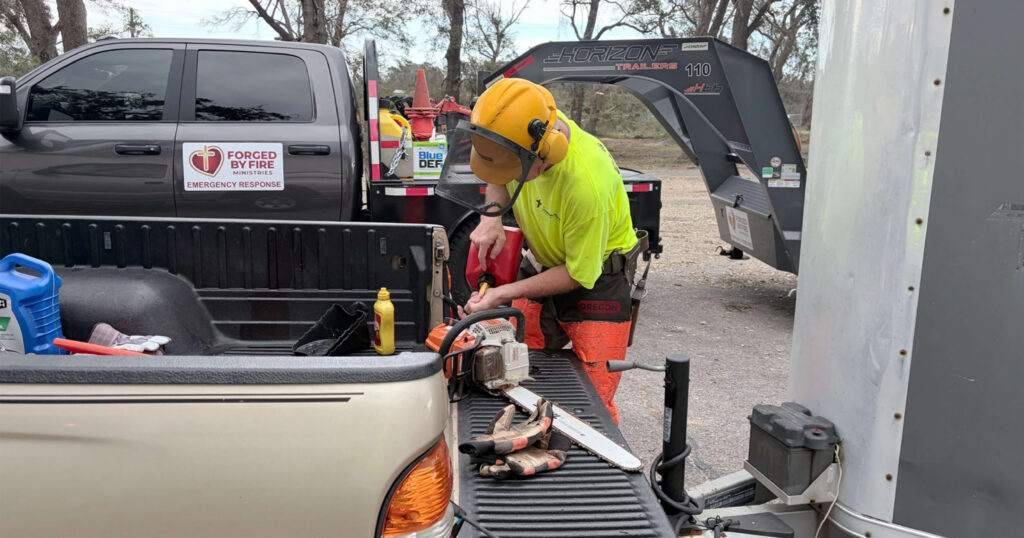
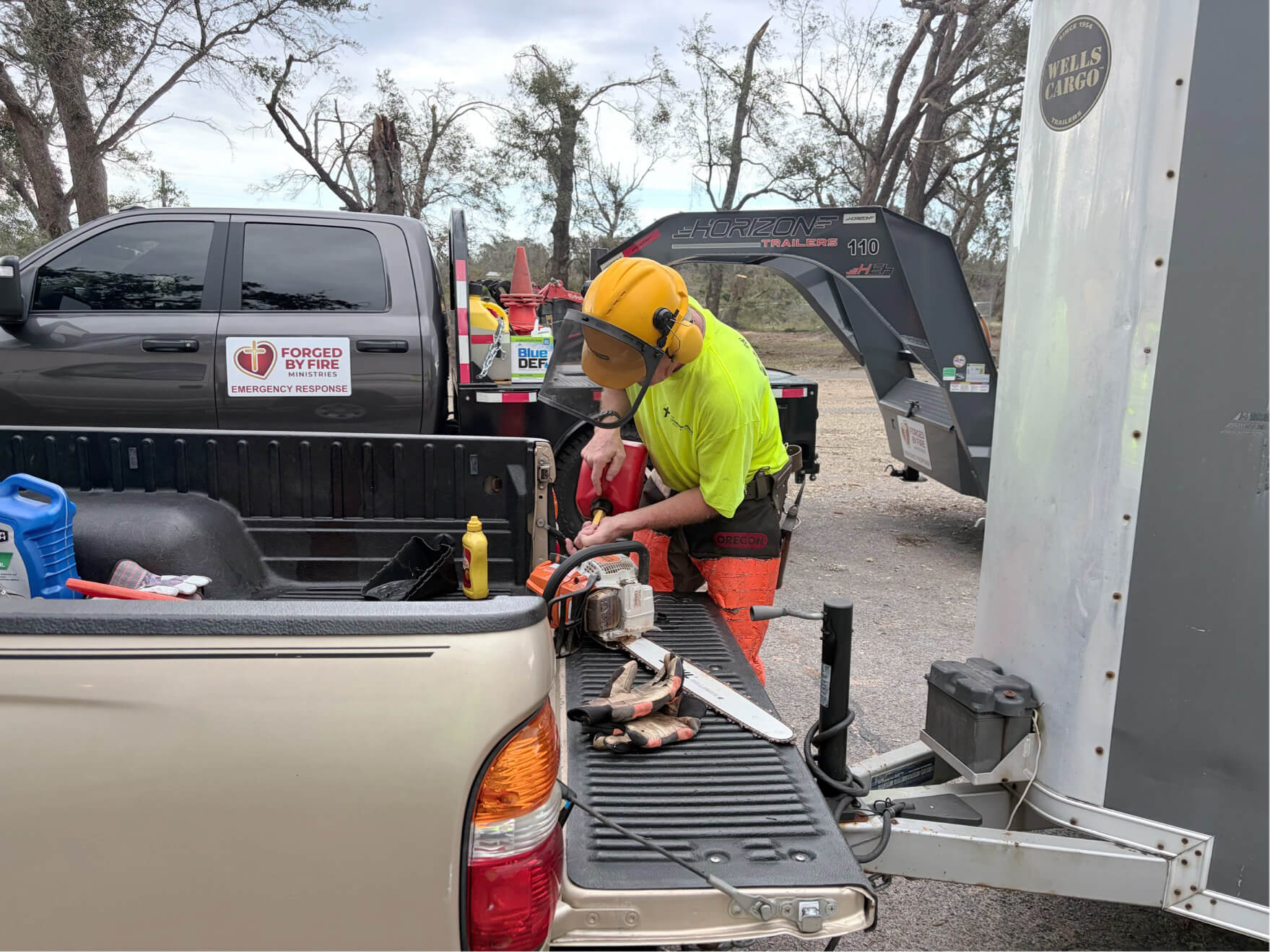
Further inland, Eternal Trinity Lutheran Church in Milton, Fla., had huge live oak trees down all around the property. Thankfully, none of them damaged the building: “Everywhere you look [in Milton], there’s a tree down,” said Ernewein. Although the church received an estimate that it would take a full week to clear the hulking trunks from their property, LERT volunteers were able to clear them in only two days.
LERT tree removal services are provided free of charge, often alleviating the burden of significant expense from those who receive aid, as tree removal is frequently not covered by insurance. The Rev. Eric Johnson, president of the LCMS Southern District, shared that the Rev. Randy Blankschaen of Immanuel Lutheran Church in Pensacola, Fla., had been told that it would cost $7,000 to remove the giant trees on his property. LERT was able to clear them for free.
About 35 volunteers — primarily from the LCMS Southern, Florida-Georgia and Texas districts and from Illinois — are serving these areas now, with over 1,000 hours logged and over 150 job requests as of Oct. 21. LCMS Disaster Response quickly released a grant of $39,000 to the LCMS Southern District for establishing and running two volunteer camps for approximately 30 days, with the possibility that the work could be extended.
A launchpad for building relationships
Following the devastation of Hurricane Katrina in 2005 and years of other hurricanes along the Gulf Coast, such as Hurricane Sally in 2020, the LCMS Southern District, in partnership with LCMS Disaster Response, developed eight LCMS congregations across the Gulf Coast as potential hubs to be used by future LERT volunteers as operational basecamps. These eight church properties — one of which was Good Shepherd Lutheran Church in Shalimar, Fla. — were outfitted with the infrastructure needed to support the cohort of RVs and equipment that accompany volunteers. Now, in the wake of Isaias, Good Shepherd, Shalimar, received its first call to be activated as a LERT base.
The damage in Shalimar was not as significant as that in the cities to the west, making it “the perfect location for the LERT team to set up and be able to use our facilities,” said the Rev. Eric Klemme, pastor at Good Shepherd, Shalimar.
Klemme, who has weathered five hurricanes in 10 years of serving in the Southern District, had one large tree down across his fence, striking his neighbor’s home and truck. LERT was quick to help him out. As Johnson emphasizes, LERT prioritizes “getting our pastors and our buildings and our people back up and running … so that they can serve their neighbor.”
“We moved into a new house last year,” said Klemme, “and [prior to Isaias], like in most neighborhoods where we’ve lived, we didn’t really see our neighbors. Nobody really talked to each other.” However, when LERT came by to help, they ended up offering help to the whole block, sparking moments of connection and laying the groundwork for new relationships to take root: “It took a disaster to bring the neighborhood out to meet each other.”
Klemme is grateful for the opportunity to reach his community. “Ministry is all about relationships — building those relationships and serving people the way Christ loved and served us. … If we’re not out beyond the walls of our sanctuary, meeting people, serving the community … would the community even notice if our church were gone?”
LERT strives to serve as a point of connection between the community and the local congregation. As Johnson puts it, LCMS Disaster Response is “not a hit-and-run” kind of operation. By pointing to the congregation, LCMS volunteers make clear that “we’re going to be there for the long term … letting the community know that the Lutheran churches are there, and that they can look to us for assistance.”
For Klemme and other members, the presence of LERT means that in the weeks after the storm, when they encounter strangers at the grocery store or doctor’s office, they can strike up a conversation and offer neighbors service through LERT, reaching out with Christ’s mercy to bring about what could be a lasting relationship with the church.
‘The church coming together’
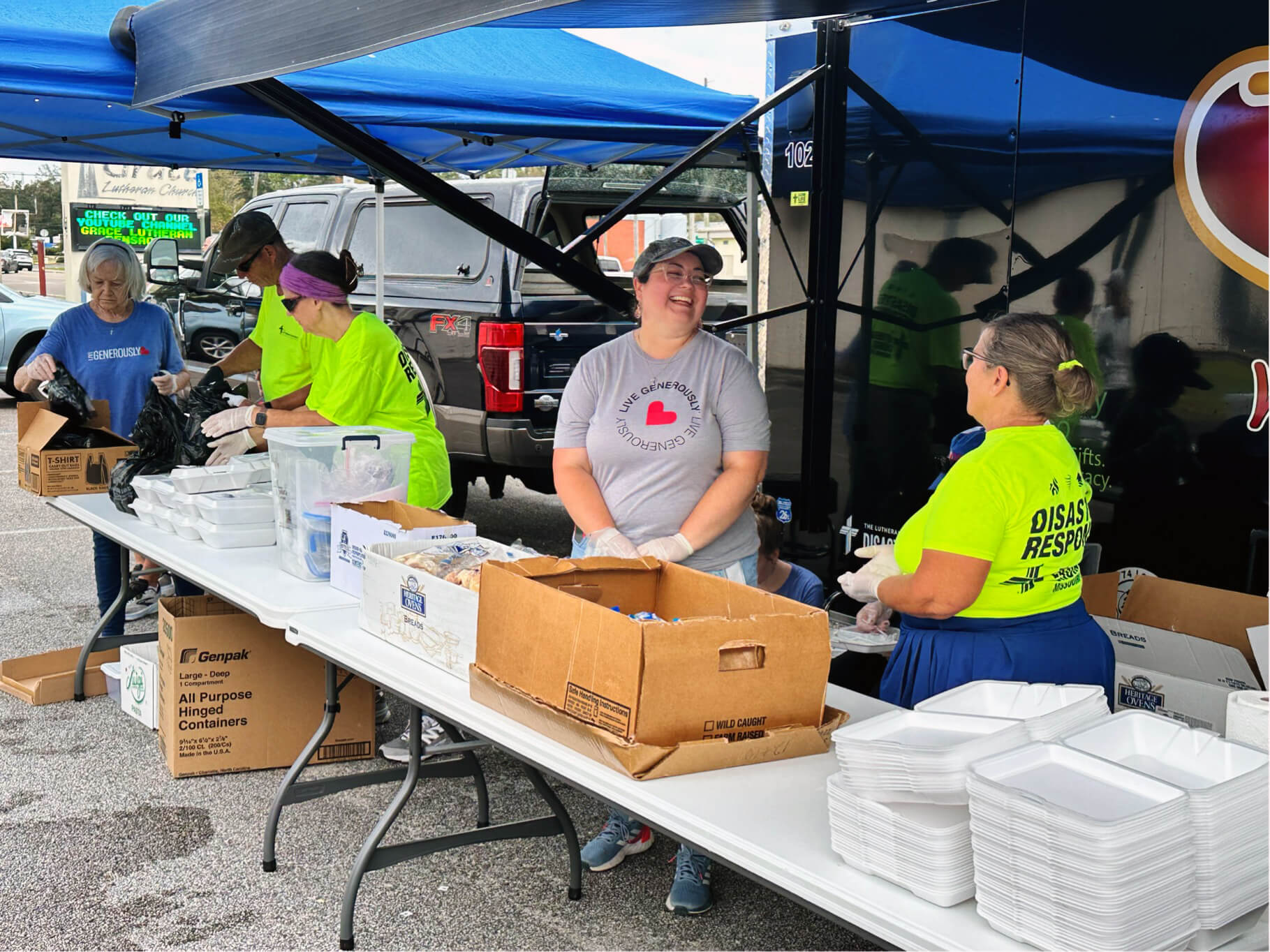
In addition to helping with tree removal, Lutherans have been responding to Isaias by feeding people affected by the storm through Forged by Fire Ministries, a Recognized Service Organization (RSO) of the LCMS that received a $20,000 grant from the Synod following Isaias to serve these communities with food and Gospel comfort.
Forged by Fire, headed by DDRC Ernewein, brings kitchen trailers to local LCMS churches, where they serve about 1,200 meals at every event. In the wake of Isaias, they served multiple days out of Grace, Pensacola, and Good Shepherd, Gulf Breeze. In addition to hot meals such as jambalaya and shrimp pasta, the ministry also handed out boxes with 4–5 days’ worth of shelf-stable food and cross necklaces.
“There’s that opportunity to proclaim Christ and the resurrection in the darkest hour” at these events, says Ernewein. “People are completely overwhelmed. Whether they have minimal or catastrophic damage, very often people don’t know what to do next. And when you’re able to provide a meal for them that they didn’t have to cook or worry about [or] you’re able to take care of the trees … [or] say, ‘We’ll do as much as we can to make you whole again,’ that’s the power of the church coming together.”
Forged by Fire has encouraged several congregations to start their own food ministry — now including Good Shepherd, Shalimar. The RSO had planned to do a feeding event in Shalimar but pivoted to areas in the west where Isaias’ destruction hit harder. Nevertheless, Klemme is hoping that Good Shepherd will be able to open its doors to feed its community in the coming days, with the intent that the meal could “segue into a regular event, where we just feed our neighbors and meet our people.”
“Lutherans are the king of potlucks,” said Ernewein. “I try to encourage people to use their talents in this way because it is a way to serve the Lord and serve the church and the community. And who doesn’t like good food?”
“Sometimes people are worried about how ‘scary’ outreach can be,” continued Ernewein. “But it’s not. These are opportunities. People are so open to having a prayer … If someone wants to pray, we’ll pray with them. … We witness not just with our actions, but with the Gospel, through our words. We don’t shy away from that.”
Ernewein asked for prayers for those in the field: “It’s hard work. They work out in the heat. They cut trees and drag limbs, they’re operating equipment — they’re a huge blessing to the church.”
Ernewein and Johnson also expressed their thankfulness for LCMS Disaster Response at the Synod level: “We have a great relationship with them, and I’m incredibly thankful for the Synod’s assistance because we couldn’t do all the things that we do without [it],” said Johnson.
“The wonderful work of our LERT volunteers in this response has benefited from years of strategic investment in LERT training and capacity-building,” said Meyer. “Would volunteers have come out anyway? Yes, because that’s what Lutherans do — they love and serve their neighbor.
“Yet walking together in training and capacity-building before disasters allows our volunteers to safely and confidently do so much more during and after disasters, giving them even more opportunities to help people in their bodies and, most importantly, to help people in their souls as they share the hope that lies within them: Jesus Christ.”
Give to the LCMS Southern District.
Give to LCMS Disaster Response.
Posted Oct. 28, 2026

