By Molly Lackey
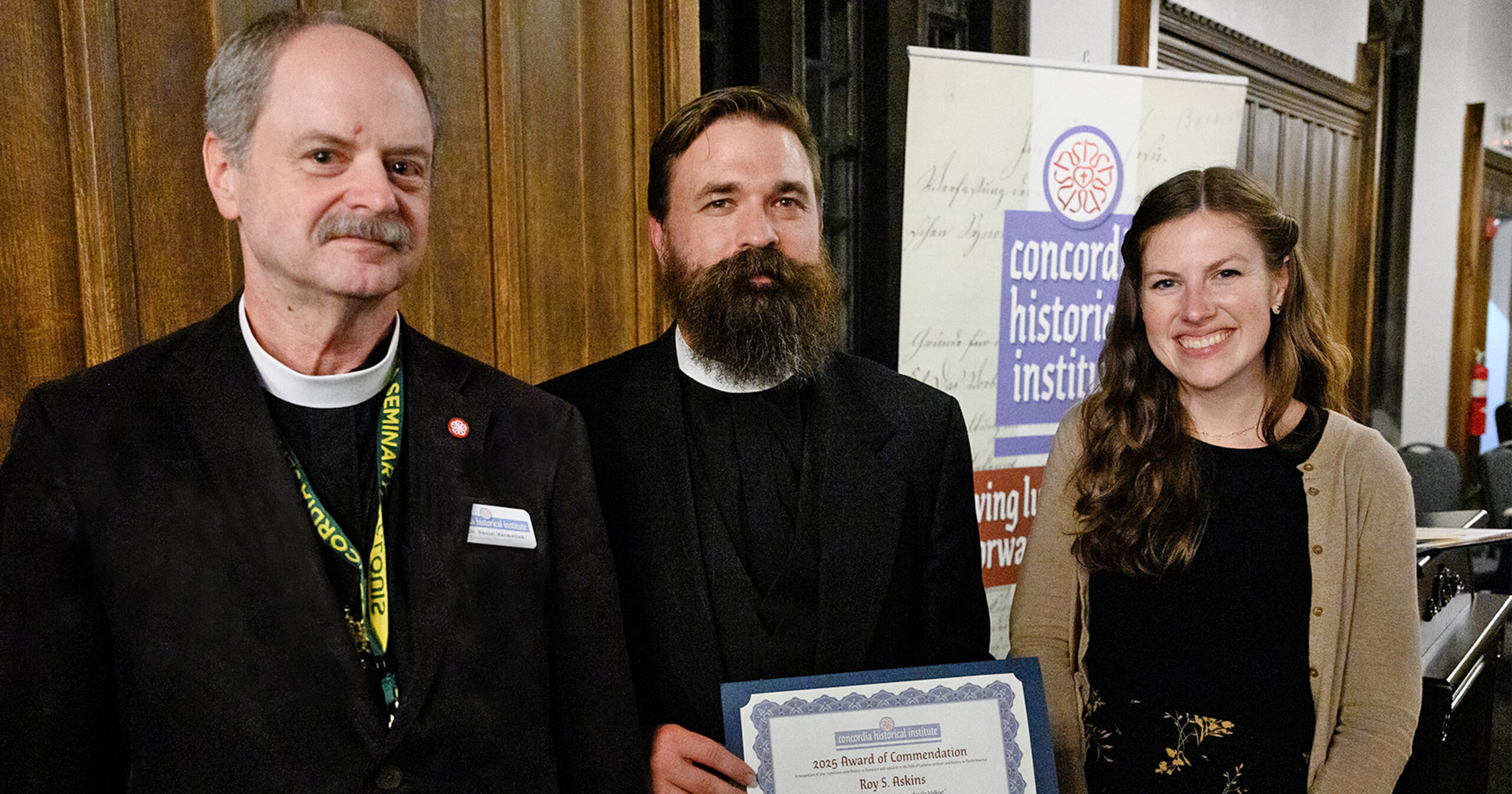
Every year, Concordia Historical Institute (CHI), the official department of archives and history for The Lutheran Church—Missouri Synod (LCMS), dedicates an evening to celebrating significant works in the field of Lutheran history that were published in the previous year. On Nov. 6, CHI honored the editors and authors of the February 2024 issue of The Lutheran Witness, “Broken Community: Fifty Years after the Walkout,” during its annual awards banquet.
Scholars of all stripes joined CHI members, donors and staff for a dinner, hymn sing and presentation from the Rev. Dr. Ted Krey, director of the LCMS Latin America and the Caribbean region. Krey’s presentation, “Repent, Remember, Rejoice,” looked at the history of LCMS missions in Latin America. His talk, sharing the stories of specific early Missouri missionaries’ hard-won success in Latin America, also tied in with CHI’s ongoing museum exhibit of the same name. Both presentation and exhibit are in honor of 125 years of LCMS mission work in Latin America, which the Synod celebrated this summer.
Awardees at the festive evening ranged from St. Louis metro natives to Swedish historian Bodil Stenseth, whose writing on a Norwegian American Lutheran pastor won one of the awards for a major work. Other topics treated in honored works included Black Lutheran congregations and church workers, congregational histories, and a history of Lutheran hymnals from 1524 to 2024. The list of award winners, as well as a bibliography of all the works of American Lutheran history published last year, is available at thelc.ms/chi-2025-awards.
“For 52 years now, CHI has spotlighted those who have crafted some aspect of the Lutheran story and shared it with the church and community,” said the Rev. Dr. Daniel N. Harmelink, executive director of CHI. “We’re excited to get the word out as we encourage friends and members to deepen their understanding of the fascinatingly complicated history of Lutheran faith and life as presented by this year’s recipients.”
The Rev. Todd Zittlow, CHI archivist, concurred and added that the banquet also “raises the public profile of Concordia Historical Institute by trumpeting CHI’s holdings as a vibrant and in-depth resource for future historical research.” This was certainly true for the Witness issue honored at this year’s awards banquet, which made ample use of CHI resources.
“Broken Community: Fifty Years after the Walkout” dealt with the 1974 Concordia Seminary Walkout, where most of the faculty and student body of Concordia Seminary, St. Louis, dramatically left campus to protest ecclesiastical oversight actions taken against the seminary by the Synod. After lay delegates complained of new pastors preaching false doctrine at the 1973 Synod convention in New Orleans, the Synod and its president, the Rev. Dr. J.A.O. Preus II, became concerned over the curriculum and teaching at the seminary.
An investigation uncovered that there was large-scale doctrinal chaos on campus, with theological modernism being the norm in the classroom and some professors going so far as to deny the resurrection of the dead or the historical reality of Christ. The result was Preus suspending the seminary’s president, the Rev. Dr. John Tietjen. The professors and students viewed this as an overreach and miscarriage of justice, and on Feb. 19, 1974, most of campus drove crosses bearing their names into the quad in a mock-graveyard scene and marched off campus, with the intent of continuing their education as the Seminary in Exile, or “Seminex.”
CHI’s commendation of the Witness’ Walkout issue highlighted the accessibility of the issue to an audience that may be unfamiliar with this historically significant event in Synod history. “With fifty years of perspective,” wrote the award committee, “this issue skillfully presents the historical details of the Walkout at Concordia Seminary in a way that is both approachable and insightful.” The issue’s articles ranged widely, from an explanation of the theological issues surrounding the Walkout, like Gospel reductionism and the historical-critical method, to the parallel theological movements and subsequent walkout that occurred in the missions department of the Synod.
“I was a blissfully unaware 12-year-old when the ‘Walkout’ of all but five professors occurred on that fateful day in 1974,” wrote the Rev. Dr. Matthew C. Harrison, president of the LCMS, in his letter from the president in the issue. Many in the Synod today are too young to remember the Walkout and the subsequent split across the Synod, if they had even been born yet. Others remember it all too well, still mourning the rift it created in their relationships with friends, family members, pastors and fellow churchgoers. Resources like this can help bridge the gap between those who lived through the trauma of the Walkout and those who didn’t, allowing both parties to take the important lessons of the past into the present and the future.
The Rev. Roy S. Askins, then-managing editor of The Lutheran Witness, had the following to say in his response:
“The story of Seminex is a vital story for understanding where the Missouri Synod has come from and how the Lord has preserved the LCMS from tragic error. On behalf of The Lutheran Witness and the writers, editors and staff of LW, I’m honored to receive this award. No editor publishes a magazine alone, and I depend on them entirely. Concordia Historical Institute’s place in preserving the LCMS’ history is crucial as the LCMS looks to her future here and around the world.”
Posted Nov. 25, 2025