By Mary Henrichs
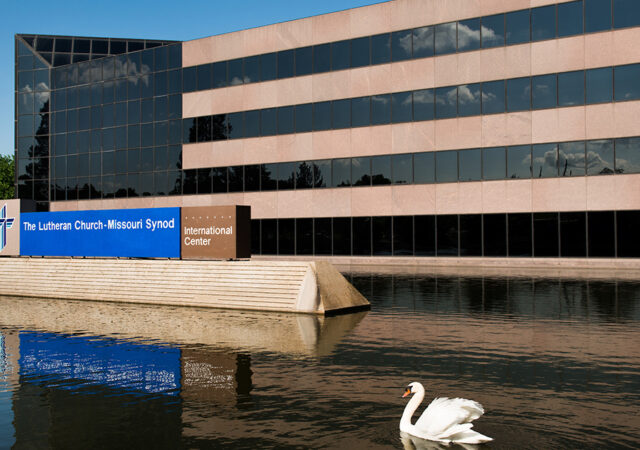
As 43 disaster response leaders from across the nation gathered for a strategic planning conference held April 16–17 at The Lutheran Church—Missouri Synod (LCMS) International Center (IC) in St. Louis, a common theme emerged from national and local leaders alike: an emphasis on strengthening readiness.
Toward the start of the conference, the Rev. Dr. Ross Johnson, director of LCMS Disaster Response, shared that the ministry received a $1 million implementation grant from Lilly Endowment Inc. for the purpose of “building sustainable readiness before a disaster occurs.” Much of the grant will be dispersed to districts and Recognized Service Organizations (RSOs) to fund major purchases — aerial lifts, skid steers, stump grinders, heavy-duty trucks and more — expanding LCMS disaster response capabilities nationwide.
Growing expertise
In addition to equipment purchases, LCMS Disaster Response is strengthening its volunteer teams with the knowledge they need to be effective in the field. The Lutheran Early Response Team (LERT) curriculum has been reworked, and new courses with video modules are being added to an online learning platform for continuing education.
Chainsaw training has also been reworked: Rather than two levels, the chainsaw curriculum will now offer three levels of training. The added level will keep the first level beginner friendly while allowing those who discover a passion for chainsaw cleanup to reach a higher level of learning.
The added level of chainsaw training is indicative of just how far LCMS Disaster Response has advanced in terms of expertise. Marty Johnson, a chainsaw instructor who serves with Lutheran Church Charities, an RSO, recalled how in the past, LERT would often encounter storm damage they were unequipped to handle.
Despite their desire to help their neighbor, in those cases, teams would have no choice but to walk away due to lack of equipment or training. These days, he says, they can tackle almost anything: “Power lines are about the only thing we can’t do.”
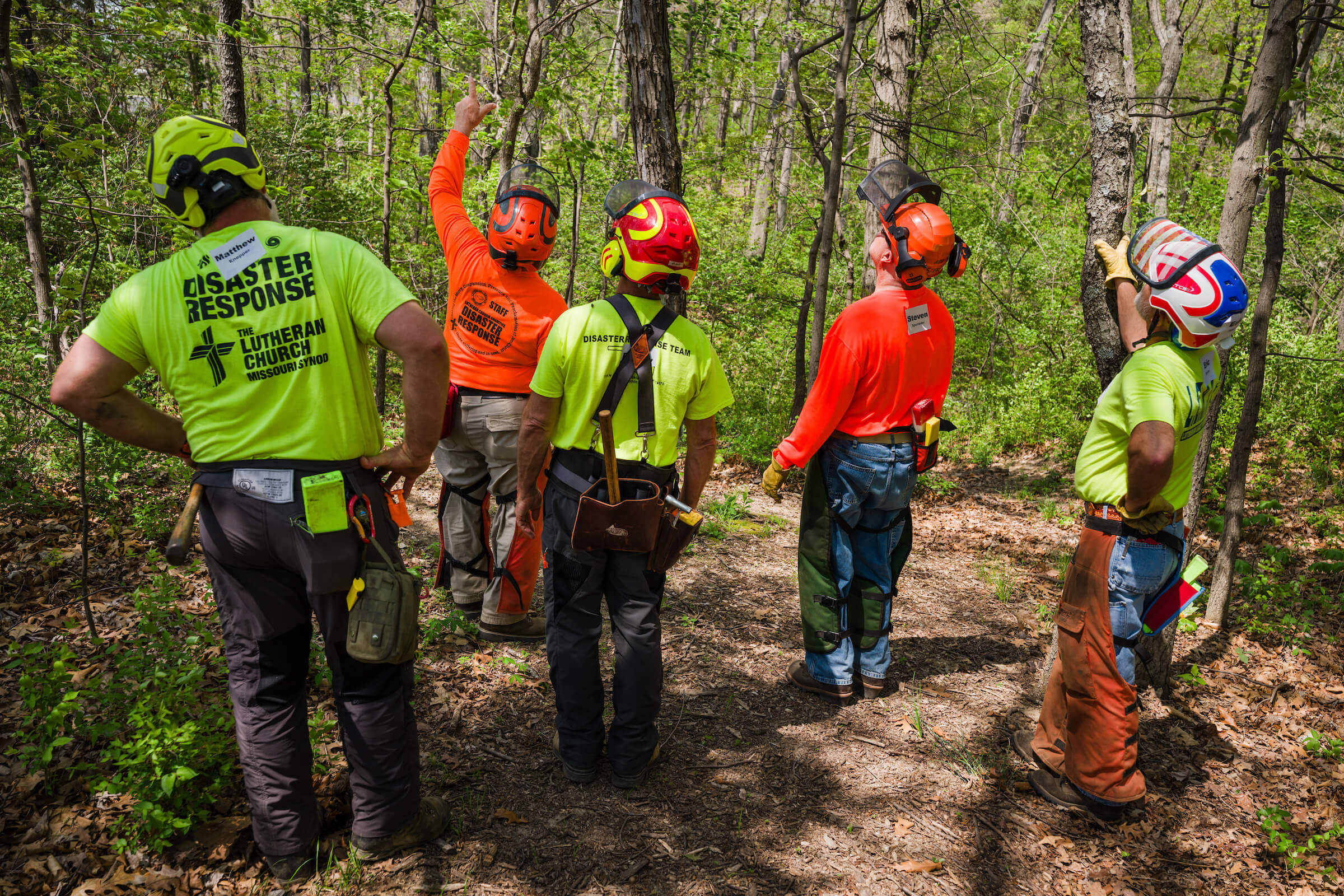
Marty Johnson was among the 25 seasoned disaster response volunteers who, for three days prior to the strategic planning conference, took up residence at Camp Wartburg in Waterloo, Ill., to participate in an advanced tree-felling and storm-clearing course offered by LCMS Disaster Response.
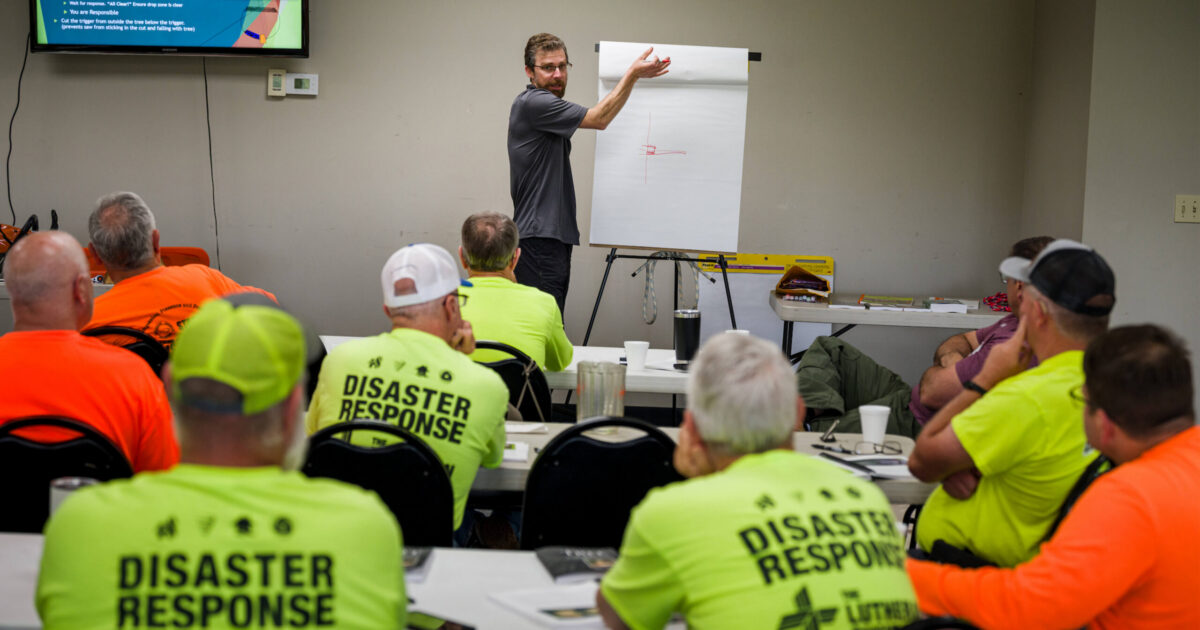
The goal of this unusually specialized cohort — made up of LERT trainers and men who have been through at least one advanced course like it before — was not just to understand the material, but to “run through the curriculum that we’re going to be using as trainers,” ensuring that the content is “technically accurate,” said instructor Ricky Gross, who led the classroom portion each morning.
Gross, who works with Shepherd’s Heart Disaster Response Ministry, another RSO, first got involved with disaster response when he deployed in 2016 to assist with the response to flooding in Baton Rouge, La. His chainsaw training came the next year after Hurricane Harvey, and he’s since become an expert arborist.
After mornings of complex calculations concerning concepts like lay and lean, wind and weight, height and diameter, crown displacement and codominant stems, the group put their learning into practice each afternoon in the woods of Camp Wartburg, felling challenging trees with advanced techniques.
‘A light to their community’
Back at the IC, leaders discussed the spiritual component of disaster response, both in terms of caring for those who care and of witnessing to Christ while on the field.
Ross Johnson presented on acedia — a loss of spiritual strength to which disaster responders may be particularly vulnerable. “Leaders often work in places of devastation, not triumph. Mercy work often looks small compared to the scale of desolation,” he said. Even so, “Christ is greater. He knows the weary. He does not despise the faint of heart.”
Attendees discussed the importance of connecting the people they serve to the local congregation and eagerly exchanged ideas for facilitating that partnership. “Christ is present with us in the ways He has promised to be — in His Word and Sacraments,” said the Rev. Dr. Brian Heller, manager of mercy training for the LCMS Office of National Mission. “When we serve [through LERT teams], we’re serving as extensions of the local congregation.”
Heller spoke about an online course in development to further equip LERT volunteers to witness to Christ. He also gave an update on a new Disaster Response Bible study meant to encourage an understanding of the theology behind Lutheran mercy work, emboldening pastors and congregations to be a light to their community. The Bible study will be available this fall.
“Long after the debris is cleared away, it is the mercy, presence and promises of Jesus that continue to sustain hurting people and give lasting hope,” said Ross Johnson. “We bring practical help because Christ has first shown mercy to us, and we remain confident that even in the darkest moments, the Lord is still at work through His Word, His people and His promises.”
Mary Henrichs (mary.henrichs@lcms.org) is a staff writer for LCMS Communications.
Posted May 22, 2026