By Rachel Bomberger
Brotherly love, confessional solidarity and mutual encouragement were the orders of the day throughout the 2026 International Church Relations Conference (ICRC), held July 16–27 under the theme (inspired by Lutheran Service Book [LSB] 468) “I Am Content! My Jesus Ever Lives!”
Sister and associate church leaders from 43 different countries on six continents came together for study and fellowship, hosted by The Lutheran Church—Missouri Synod (LCMS). Although the annual conference most often takes place in Wittenberg, Germany, this year’s meeting was held concurrently with the LCMS convention in Phoenix.
Sharing global challenges
During their time together, visiting leaders appreciated the opportunity to share the challenges their churches face and hear how fellow bishops and presidents have navigated similar difficulties.
In the Lutheran Church in Norway and Iceland, which is, as Bishop Rev. Torkild Masvie says, both “very young and very old” (having its roots in the Reformation but becoming incorporated only in 2006), church planters have had to craft innovative strategies, starting congregations with as few as two members, rather than the conventional 20. The church owns only two buildings — the rest are rented spaces — and all its pastors are worker-priests. “I was traffic manager at the bus terminal,” said Masvie.
In Lithuania, which unlike the neighboring Baltic States of Estonia and Latvia has been Catholic-majority since the Reformation and is now increasingly atheistic, Lutherans are a tiny minority — and have been for centuries.
“Each generation of Lutherans in Lithuania thought that they are probably the last generation of Lutherans,” said the Rev. Mindaugas Sabutis, bishop of the Evangelical Lutheran Church in Lithuania.
The Evangelical Lutheran Church of Brazil is grappling with relativism; the Evangelical Lutheran Church in Kenya is fighting the Prosperity Gospel; the Free Evangelical Lutheran Synod in South Africa is dealing with isolation. And in Nigeria, physical persecution is becoming more frequent and more violent, especially in the Muslim-majority north.
“Nigeria is actually bleeding,” said the Rev. Dr. Christian Ekong, archbishop of the Lutheran Church of Nigeria. “We ask our Christian brothers the world over to remember us in their prayers as we face persecution of Christians in the country of Nigeria daily. Families are displaced; communities are displaced; churches are burnt down; Christians are killed. … [It’s] been really, really inhuman. And of course, to them — they feel killing is the right thing because they do not know peace. Of course, how would they know peace when they do not know Christ?”
Contentment in Christ: Presentations and papers
Ekong was one of four leaders — together with Argentina’s Rev. Arturo Truenow, Canada’s Rev. Timothy Teuscher and Taiwan’s Rev. Chun-Tzu “Kevin” Ko — to present to the gathered body the unique contexts and opportunities facing his church body.
Participants also enjoyed receiving the heart of the ICRC26 symposium: four essays focused on Christ and the contentment His resurrection brings. Papers were based on Easter texts and the four stanzas of LSB 468:
- “Jesus Is My Righteousness (Matt. 28:28–20, LSB 468:1)” by the Rev. Dr. Jonathan Shaw, director of LCMS Church Relations;
- “Jesus Is My Head (Mark 16:5–7, LSB 468:2)” by the Rev. Omar Marin Garza Martinez, president of the Lutheran Synod of Mexico;
- “Jesus Is My Light (Luke 24:13–35, LSB 468:3)” by the Rev. Tapani Simojoki, bishop of the Evangelical Lutheran Church of England; and
- “Jesus Is My Salvation (John 20:19–31, LSB 468:4)” by the Rev. Dr. Richard Stuckwisch, president of the LCMS Indiana District.
Questions and a time for discussion followed each paper, as participants delved more deeply into the ideas presented, making these portions of the conference a highlight for many guests.
On Tuesday, July 21, Shaw presented the work of LCMS Church Relations to the convention. He highlighted the ICRC both as a living church body fellowship with sister churches united in the Gospel in all its articles, and as an annual symposium with sister and associate churches growing together and supporting each other in faith and life.
“Through [the] LCMS International Church Relations office, we have actually drawn deeper into the understanding of the Word of God and also the study of the Confessions,” said the Rev. Joseph Ochola Omolo, archbishop of the Evangelical Lutheran Church in Kenya (ELCK), in his remarks to convention delegates and as he recalled ICRC gatherings past and present.
“It is a great privilege to know that, in the world where there are so many winds flowing here and there, there are other brothers who stick to the Gospel, who stick to the power and the authority of the Scripture, and who walk together with us.”
“I Am Content!”
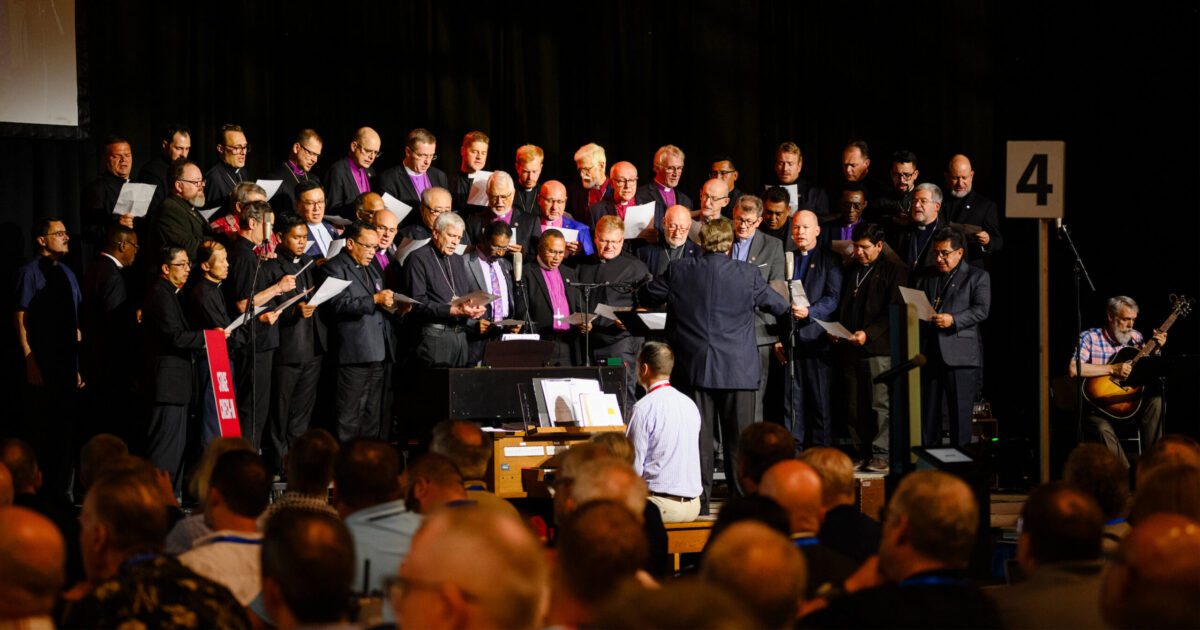
Fifty-one church body presidents and bishops attended this year’s ICRC. A high point for many LCMS convention delegates was the conclusion of the Church Relations presentation. Visiting bishops and presidents formed a choir under the direction of the Rev. James Krikava and performed in unison the hymn “I Am Content! My Jesus Ever Lives,” accompanied by guitarist Rob Bourassa, before the gathered assembly. The ensemble sang stanza 1 in German and stanza 3 in Spanish; Krikava sang stanza 2 as a solo in Czech. The entire convention stood and, with organ accompaniment, sang stanza 4 in English.
Following the choral performance, each visitor was introduced to the convention and greeted personally by LCMS President Rev. Dr. Matthew C. Harrison, another convention highlight.
A new sister church — the Evangelical Lutheran Christian Church of Bolivia (ICEL) — was recognized and welcomed. LCMS delegates also rose and gave thanks for Lutheran Mission–Australia (LM–A), with which they anticipated recognizing church fellowship pending the LM–A’s constituting convention Aug. 27–30, 2026, in Hamilton, VIC, Australia.
Mutual encouragement
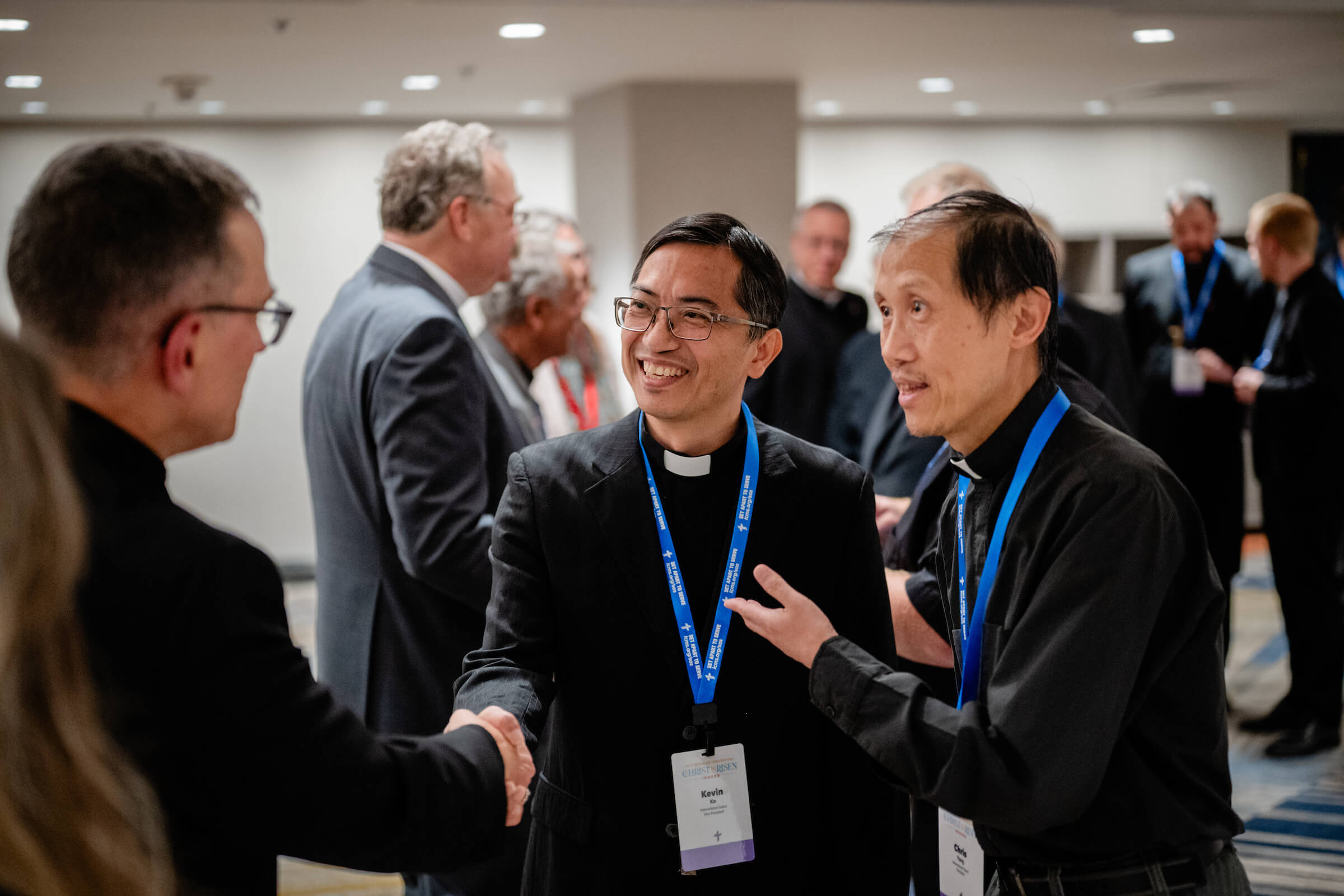
Throughout the week, visiting church leaders enjoyed opportunities to worship and study, listen and learn, sing, pray and eat together — and for many, “together” was the whole point.
Most of the churches represented at the ICRC are numerically tiny in comparison to the LCMS. The Portuguese Evangelical Lutheran Church, for instance, has only 200 members in total, according to President Rev. Adalberto Hiller. Many other church bodies count their congregations by the dozens, not the thousands.
“I came here to pick [up] encouragement,” said Hiller, “and I go back with a lot of encouragement.”
The Rev. Helmut Paul, bishop of the Free Evangelical Lutheran Synod in South Africa, echoed Hiller’s sentiments. LCMS fellowship and International Lutheran Council (ILC) membership (both established in 1995), he said, have “helped us to really see a bigger world.” One of the biggest challenges his church faces, Paul says, is to understand themselves “not simply as a small, isolated group of German-speaking people” but, rather, “to see that Lutheranism is worldwide.” Merely witnessing the scope of the LCMS convention, with delegates numbering almost as many people as there are in his entire church body — “It’s an encouragement.”
“When we meet together like this,” said the Rev. John Donkoh, president of the Evangelical Lutheran Church of Ghana, “we learn for ourselves some of the experiences and the joys [other church bodies] have. We learn, encourage and strengthen ourselves through the common teachings or doctrine that we have. … It has been a blessing coming together to know what is going on in other parts of the world and what they have been able to overcome.”
View videos of conference papers given during the 2025 ICRC, held Oct. 21–25 in Wittenberg, Germany.
Find complete coverage of the LCMS convention, including statements from partner church bodies.
Unless otherwise indicated, quotes in this article are taken from a series of interviews recorded during the ICRC by KFUO Radio in partnership with The Lutheran Witness and scheduled for release later this summer.
Posted Aug. 5, 2026

